Book Title: Ahimsa: 100 Reflections on the Harappan Civilization
Author: Devdutt Pattanaik
Publisher: HarperCollins India
Number of Pages: 272
ISBN: 978-9365699371
Date Published: Sept. 30, 2024
Price: INR 358
Book Excerpt
Chapter 7
Nazar or Evil Eye
Pg. 43 – 44
Even today, from West Asia to South Asia, across the Middle East, people believe in ‘nazar’ or the evil eye. When this strikes, people become weak, tired, dehydrated and listless. It is linked with aridity. To counter it, one needs moisture—and salt, which retains moisture. So the talisman used even today to protect people from the evil eye is a fish-eye shaped amulet, ringed with white and blue.
Fish, with their unblinking eyes in constant contact with water, may have inspired the design. The many types of fish symbols used in Harappan script may be lined to these beads used to make fish-eye amulets.
The fish-eye amulet is seen on the head and the arm of the ‘priest-king’, an inlay work of Harappan craftsmen. The location on the head makes one wonder if Harappans believed in the ‘third eye’. Those who practice aura therapy today believe lapis lazuli is for the third-eye chakra, turquoise for the throat-chakra, and carnelian for the solar plexus. It is not impossible that ancient Sumerians and Harappans had similar beliefs.
Sumerian mythology speaks of terrifying ‘galla’ demons of the underworld who experience no pleasure and derive nourishment from other people’s pain. Even gods needed spells to protect themselves.

Chapter 8
Hunger and Fear
Pg. 45 – 46
All living organisms seek food. Harrapan seals depict images of crocodiles eating fish, a reminder of the law of the jungle. Harappans showed food trays before animals to symbolize the yearning for resources—need, greed, ambition.
No animal wants to become food. Horns are used by animals to fight predators, establish territory and the pecking order. Harappans used horns as symbols of power.
In later Hindu lore, one-horned beings are linked to contentment and caring.
- Ganesha, linked to contentment, breaks one of his tusks and uses it as a stylus to write a story about the futility of war. He is known as eka-danta (one-tusked).
- Vishnu, linked to security, takes the form of a one-horned (eka-shringa) fish (matsya) to tow Manu’s ship to safety during a storm.
- Shiva, who overpowers hunger, is called eka-pada (one who balances himself on one leg).
The ‘Pashupati’ seals shows animals like the rhinoceros and elephant that were believed to have no natural predator. This indicates luck. The same seal also shows the horned sage separating the tiger (predator) form the buffalo (prey) and the goat (prey). In the presence of a sage, the tiger (vagh) does not attack the goat (bakri). This is how Dilmun, the paradise of Sumerian mythology, is also described.
Chapter 9
Fertility and Sacrifice
Pg. 47
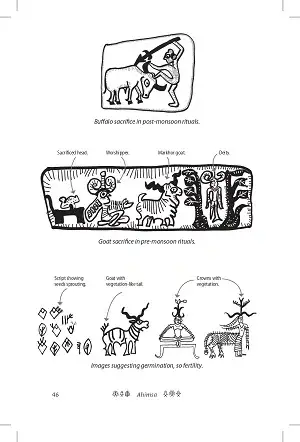
Many symbols in the Harappan script show a yearning for blossoming and germination—in other words, a celebration of fertility. The four months of monsoons marked the calving and mating season of wild cattle, buffaloes and bison. It was the time when Palla fish moved upstream through the Indus to spawn. This was the time for summer crops—millets, cotton, rice. Then, after the rains, came the winter harvest of barley and wheat and peas. The nomads came down from the mountains and the goats gave birth in the spring.
So spring (before the monsoon) and autumn (after the monsoon) were times when sacrifices of male goats and male buffaloes were offered to the earth goddess, in exchange for the rich vegetation she gave. This is common in most tribal communities. The earth produces vegetation and in exchange receives blood. Harappan seal art shows the sacrifice of markhor being made to vegetation deities.
Across pastoral and agricultural communities, even today, the female is never sacrificed as she can bear children. Young virgin males are sacrificed to the goddess. Buffaloes and goats and sheep are preferred over bulls as the castrated bull (ox) can be used as a beast of burden. Thus, economics shapes what is sacrificed.
Check out our Latest Book Reviews
Excerpted with permission from Ahimsa: 100 Reflections on the Harappan Civilization by Devdutt Pattanaik, Published by HarperCollins.
Books are love!
Get a copy now!