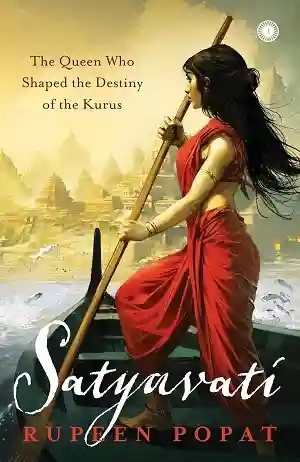
In the vast landscape of the Mahabharata, Satyavati is often remembered as the catalyst for the Kuru dynasty’s complicated lineage—a fisherman’s daughter whose ambition reshaped history. However, in this illuminating interview, Rupeen Popat, the author discusses their journey of bringing Satyavati from the periphery to the center of the narrative.
By blending the strategic acumen of a former CEO with a deep-rooted empathy fostered under the guidance of Morari Bapu, the author explores the challenges of adopting a first-person female perspective to humanize an epic queen.
From the structural influence of screenwriting to the nuances of political leadership, we delve into how this retelling balances traditional fidelity with the raw, emotional authenticity of a woman navigating power, loss, and destiny.
1. In your retelling of Satyavati, how did you balance creative liberty with the traditional narrative of the Mahabharata, especially while shaping Satyavati’s inner voice?
I took as little creative liberty as possible. My intention was to stay true to the known narrative of the Mahabharata while shining light on perspectives that have often been overlooked.
With Satyavati, I focused on stepping into her inner world, trying to understand what each defining moment must have felt like for her. I didn’t want to portray her as a martyr, nor as a hero or villain. I wanted her to be human. That was the balance – remaining faithful to the epic while deepening emotional perspective.
2. Your narrative adopts a first-person tone from Satyavati’s perspective—what challenges did you face in sustaining her emotional authenticity throughout the story?
The biggest challenge was stepping intoand staying withina female perspective throughout the narrative.To navigate this, I relied deeply on empathy. My learnings under Morari Bapu, combined with my professional experience as a founder and former CEO, where understanding people’s motivations by putting myself in their shoes was essential. This helped shape my approach to Satyavati.
Having built and led a business in early years education, working closely with a predominantly female team, I’ve spent years developing the ability to see the world through perspectives different from my own – whether across gender, age, or life experience.
So, this wasn’t about imagining Satyavati from the outside ~ it was about stepping into her reality and staying there.And hers is an extraordinary journey. She moves from being a fisherman’s daughter to a queen, then a queen mother, and ultimately a custodian of a dynasty, making decisions under immense personal and societal pressure.
I had to move away from asking, “What would I do?” and instead ask, “What must this have felt like for her?”
That shift – from projection to understanding – is where her voice came from.

3. The book highlights themes of political virtue and presence of mind—how consciously did you intend to position Satyavati as a strategist rather than just a supporting figure in the epic?
Very consciously.
Satyavati was not a background figure; she was a leader. After becoming queen, she effectively helped steer the kingdom alongside Bhishma for decades. This is not a minor role; this is sustained leadership over 30–40 years. She lost her husband, lost her sons, and still ensured the continuation of the Kuru lineage. That required intelligence, resilience, and strategy.
In many ways, I see this as a correction – bringing rightful attention to the influence she truly had.
4. You begin with Sage Vasiṣṭha’s curse and connect it to Bhīṣma’s origin—what inspired this structural choice, and how does it influence the reader’s perception of fate and destiny in your story?
Bhishma has always been one of my favourite characters in the Mahabharata.
In many ways, this book is as much his story as it is Satyavati’s. His life is defined by sacrifice, duty, and ultimately suffering. There is no traditional “victory” for him.
Starting with that foundation sets the tone – that destiny is already in motion. It prepares the reader to understand that certain outcomes are inevitable, and that Bhishma’s path, however noble, is one of profound cost.
Also Read: Book Review: ‘From Chaos to Clarity’ by Shonali Sabherwal
5. The book follows a “free-flow writing” style resembling a screenplay—was this a deliberate stylistic decision to make mythological storytelling more accessible to modern readers?
Not entirely deliberate.
Interestingly, I initially wrote the story as a screenplay and later adapted it into a novel. So that influence naturally remained.
At the same time, I think my background – writing in English from a UK perspective, may bring a slightly different tone compared to traditional Indian English narratives. Perhaps that contributes to the pacing and accessibility as well.

6. Satyavati is portrayed as a multifaceted figure—queen, wife, and mother. Which of these roles was the most challenging to develop, and why?
The role of the queen, without question.
As a wife, her meaningful time with Shantanu was limited. As a mother, her role was overshadowed by early loss and the broader arc of the story.
But as a queen, she faced immense challenges. She entered Hastinapur as an outsider, following a revered queen like Ganga, and was likely unpopular. She was indirectly linked to Bhishma’s sacrifice, and her own lineage becoming rulers was a major cultural shift.
Despite all this, she had to lead, through loss, uncertainty, and political instability – without any formal preparation. That journey required strength, adaptability, and strategic clarity.
7. Why do you think reading Indian epics like the Mahabharata remains important for modern readers, especially in understanding human nature and moral complexity?
Because they are timeless. Because they’re not just stories – they’re mirrors
The Mahabharata and Ramayana explore human nature at its deepest level ~ duty, ego, sacrifice, love, ambition, conflict. These themes are as relevant today as they were thousands of years ago.
For centuries, these stories were carried through oral traditions, and even today, through storytellers like Morari Bapu, they continue to evolve and reach new audiences. The medium may change – books, television, digital – but the essence remains the same. These stories help us understand ourselves.
Check out our Latest Book Reviews
8. In today’s literary landscape, what role do women authors play in reshaping traditional narratives and bringing forward untold female perspectives?
While I am not a woman, I believe strongly in bringing forward female perspectives.
The women of the Mahabharata have not been given enough attention. We know their names, but we rarely explore their experiences in depth.
Every warrior in the Kurukshetra war had a mother, a wife, a daughter. Their emotional journeys, their losses, their strength, are just as significant.
For me, the intention was not simply to “push a female agenda,” but to find a powerful narrative lens that allows the story to be seen more completely. Satyavati provided that lens.