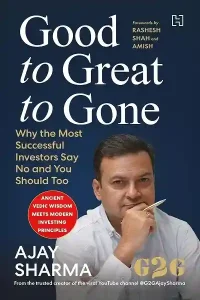
Book Title: Good to Great to Gone – Why the most successful investors say no and you should too
Author: Ajay Sharma
Publisher: Hachette India
Number of Pages: 328
ISBN: 935731878X
Date Published: Sept. 17, 2026
Book Review
Ajay Sharma’s “Good to Great to Gone” is a practical investment book built around a simple idea: companies move through cycles. A business may rise from “Good” to “Great,” but it can also slip back to “Good” or disappear entirely. Sharma’s central message is that successful investors must learn to say no—to hot tips, overpriced market favourites, and stories that sound too perfect.
His writing style is clear, confident, and conversational. Ajay blends Western investing discipline with ideas from Vedic philosophy, especially the cycle of creation, preservation, and destruction. The language is accessible for readers without a finance background, although the repeated framework can sometimes feel a little too neatly packaged for the messiness of real markets.
The chapters are arranged to move the reader from spotting strong businesses to recognising warning signs and protecting capital. Their titles are direct and memorable, reflecting the book’s focus on judgment, discipline, exits, and wealth preservation. Figures and illustrations help break up the ideas, giving visual shape to cycles, frameworks, and decision points.
The case studies in the appendix are especially useful. They ground the theory in real companies and market situations, showing how even successful businesses can lose their edge. The slight weakness is that the book leans heavily on its own G2G framework, so readers may want more discussion of when the model might fail. Still, it is a thoughtful guide to investing with patience, humility, and an exit plan.
Books are love!
Get a copy now!
About the Author
Ajay Sharma is a serial entrepreneur, investment philosopher, YouTube creator, and fund manager with more than 25 years of experience in wealth creation across Asian markets. Based in Singapore, he has managed institutional investments spanning India, China, Thailand, and other parts of Southeast Asia.
His approach to investing has been shaped by first-hand experience of major market upheavals, including the dot-com crash of 2000, the global financial crisis of 2008, and the pandemic-era market bubble of 2020–21. These experiences have informed his perspective on market behaviour, risk, and the long-term principles of wealth building.