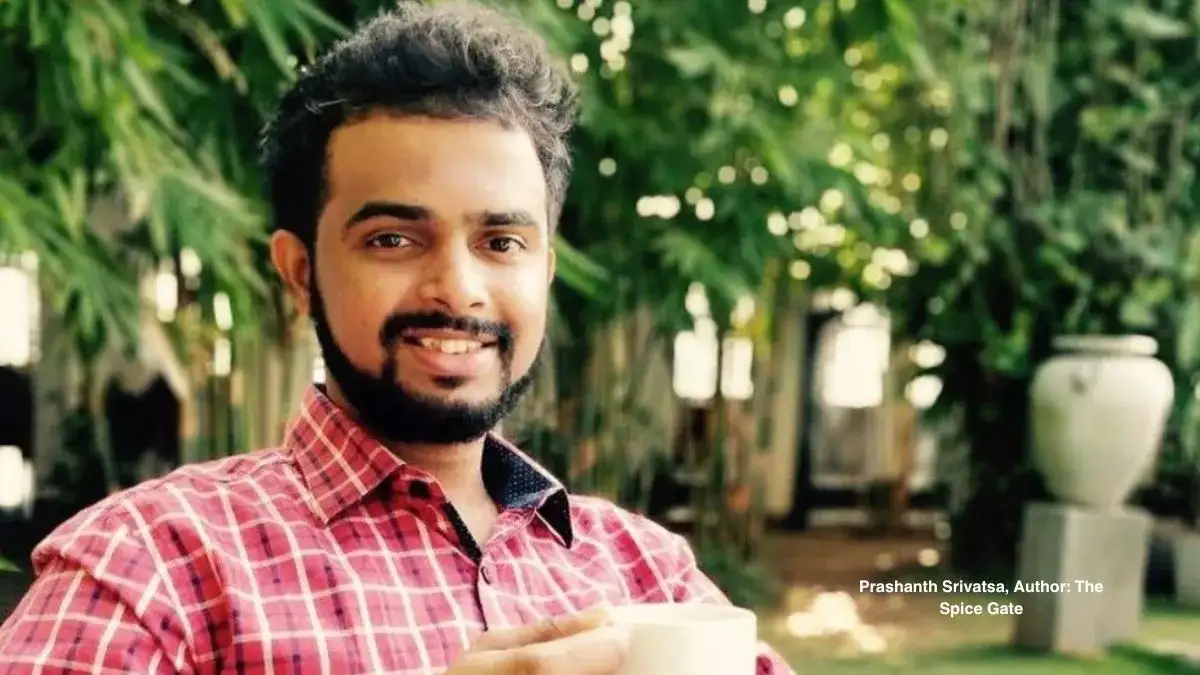
In this insightful interview, Prashanth dives deep into the world of The Spice Gate, a richly woven narrative blending the complexity of subjugation, rebellion, and hope. He shares the inspiration behind Amir, a protagonist torn between privilege and pain, and offers a glimpse into the creative process of crafting the intricate kingdoms and spice gates that define his world. From the influence of the Silk Roads to the unexpected challenges of writing during a pandemic, Prashanth reflects on how his personal experiences and research have shaped the novel’s exploration of caste, hierarchy, and resilience. Get ready to journey through an epic tale that challenges and captivates in equal measure.

1. In “The Spice Gate,” Amir’s journey is both personal and epic. What inspired you to create a protagonist with such a unique ability and background?
Amir’s journey is his need. It is driven by desperation, status and the sheer will for a better life for him and his family. Amir is constantly torn between the dichotomy of life as a Spice Carrier: the ability to traverse the eight kingdoms versus the pain, suffering and social ostracization as a result of it. I wanted a character who could navigate this duality and who could challenge the lure of stability.
2. The concept of the Spice Gates and the eight kingdoms is fascinating. Can you share more about the world-building process and how you developed the idea of spices as a central element?
It’s honestly just something that came to me one fine day. If I told you I came up with the idea when I was adding spices while cooking lunch, I’d be lying. It was an idea, and when it came to me, it sounded pretty cool in my head, and I decided to see how I could explore that further. I was always fascinated with the Silk Roads and somehow, the two thoughts merged to give birth to this fantastic world. I wanted a world where the vast distances of the Silk Roads were eliminated by means of the spice gates, and yet, the system was rigged in favor of some at the expense of others.
3. Themes of subjugation, rebellion, and the quest for freedom are central to your novel. How did you approach weaving these themes into the narrative, and what message do you hope readers take away from them?
The message is always to check your privileges. To acknowledge them, and then to work towards leveling the playing field for those who are not as privileged as you are by working together. And it is important to look at this intersectionally.
There have always been stories of rebellion and freedom. We tell stories of action and adventure because there are people who are willing to take the risk to get what they need. And these stories exist despite so called ‘advances’ in society, because we always leave something or someone behind. We don’t have time to turn back and see the long line that stretches behind us, and are too desperate to catch up to the front. The Spice Gate is a small ode to those who first want to be a part of this long, winding line, because they deserve to be, and then one day, to own the line.
4. Your writing has been praised for its immersive and richly detailed style. What techniques or strategies do you use to create such vivid and intricate worlds?
Hmm. I can’t remember any particular techniques or strategies, unfortunately. I doubt I employed any consciously. My writing is largely a product of my reading. I’ve always enjoyed works that have a rich, immersive world, and make the experience of reading transportive. I wanted to set up a world where a reader could imagine themselves to be a part of despite the harrowing experiences of its characters. I think having a lot of food in there definitely helps to make readers feel at ease and at hom. Does that count as strategy?
5. “The Spice Gate” critiques caste, religion, and hierarchy while celebrating resilience and hope. How do your personal experiences and perspectives influence these themes in your writing?
From personal experience and perspective, from the vantage of my privilege, I presume to be the oppressor. That does not make me a bad person by and itself, but that I am a part of a system that inherently favors me over few others, while there are undoubtedly those it favors over me. It takes compassion and empathy to look beyond our circle (or hexagon) to lives that are forged in resilience and hope. And once there’s compassion, you want to see that resilience and hope fulfilled.
Check out our Latest Author Interviews
6. What was the most unexpected challenge you encountered while writing a book?
Covid! Also, an awkward struggle I faced at one point was to pinpoint where this book ought to start. It had multiple beginnings over the course of time, but I do strongly feel that where it finally began is what suits it best. (unless you think otherwise, in which case I’m happy to imagine alternatives).
7. What research did you conduct for this book, and did you uncover anything surprising or fascinating?
Plenty. I read truckloads of research papers and books on the early and medieval spice trade, the Silk Roads, histories of spice-rich places in Asia such as Sri Lanka, Molucca, Malabar, etc. Never let anyone tell you that you don’t need research to write fiction. Research for fiction can drive you nuts. For beginners, I highly recommend The Taste of Conquest by Michael Krondl.
What I found fascinating was the sheer number of uses spices had besides food and status. They were used in corpse preservations, exorcisms, love & lust, perfumes, witchcraft, to summon gods, to guard against pestilence, as gifts, as a guide for mariners, etc.
8. What was the most rewarding moment you experienced during the writing process?
Beta-reader feedback, definitely. I had a few close friends who read my work, and their feedback was immense validation (even if a lot of it was critical).
Secondly, as a writer, there are these scenes you visualize. It could be as simple as two characters having a conversation, or a great sunrise on a mountain, or a thrilling reveal. But it’s something in your head that gives you direction, and keeps you going. And when you actually write down that scene you’ve been visualizing all along, and you sit back and soak it in, that’s a great feeling. I had that for the bridge battle towards the end. I always knew I wanted to write one heartstopping duel on a bridge across a treacherous waterfall, so that was extremely rewarding to see it realized on paper.
9. Can you share a behind-the-scenes anecdote or interesting fact about the creation of this book?
Amir was supposed to be a heavily chai-drinking person. Turns out, he doesn’t drink chai even once during the course of the novel, even though he talks about it a few times. I realized it too late in the publishing process. Way too late. So I wrote a small companion page for the novel that I keep for myself, which is just Amir sitting on a bench outside a tea stall in the kingdom of Talashshukh, having chai.
10. What projects are you currently working on, and can you offer any hints or teasers for your upcoming work?
I’m currently working on a couple of projects, both of which are fantasy in nature. One is an epic fantasy, again in a wholly secondary world, which has a deep, rich lore, a sassy heroine and a puzzle to solve. The other is a historical pirate fantasy structured around the ancient history of Tamil Nadu. So it has many real places and many real people, but also a lot of cool, imaginary stuff. And of course, it has pirates.
Books are Love!
Get your copy now!