In a world that rarely pauses, Ishu Bhalla gently takes us back to a time when life moved slower, relationships ran deeper, and happiness was found in the simplest of moments. Through his book Nostalgia From My Pen, he revisits an era of gullies filled with laughter, black-and-white televisions that brought neighbourhoods together, and childhood friendships that stood the test of time. In this heartfelt conversation, Bhalla opens up about the memories that shaped him, the values that still guide him, and the quiet beauty of a life once lived without rush—reminding us that sometimes, looking back is the most meaningful way to move forward.
1. In “Nostalgia From My Pen – When Life Was Simple (Growing up from Black & White to Colour – Yaadein 60–70’s ke)”, your memories unfold almost like a warm conversation over tea. What first inspired you to turn these personal moments into a book and invite readers into your world of memories?
Interestingly, this was never planned as a book in the beginning.
After spending more than four decades in corporate roles across FMCG, media and consumer businesses, writing a book on childhood nostalgia was certainly not something I had imagined — especially at this stage of life.
The real trigger came during a recent get-together with a few childhood friends in the same locality where many of us had grown up. As we started recalling those days, the conversations naturally drifted to small incidents and playful nauk-jhonk from our childhood — life in the mohalla, school memories, local games, watching movies together and even occasionally skipping classes.
That evening brought back a flood of memories.
After that, I began writing a few of those moments and casually shared them as short posts on Facebook.
What truly surprised me was the response from people outside that group. It was not just some of my old friends who connected with those stories — many others began writing back saying that these memories felt like their own childhood.
That was the moment I realised that these stories were not just personal recollections. They belonged to a whole generation that had grown up in simpler times.
That warmth and encouragement gradually led to the idea of putting these memories together as a small book.
Perhaps that is how Nostalgia From My Pen slowly found its way from casual memories into a book.
2. Your book beautifully celebrates the small, everyday moments that often go unnoticed at the time. Looking back now, was there a simple childhood memory that suddenly revealed its true importance to you while writing this book?
While writing the book, I realised that many of the memories that seemed ordinary at that time were actually the most enjoyable and meaningful.
For example, playing cricket with friends in the peak summer afternoons, especially those long Delhi summers when the streets almost became our playground.
We were also a generation that literally experienced life moving from black and white to colour — from waiting outside a neighbour’s house for our turn to enter and watch Chitrahaar or a Hindi film on Doordarshan, to later skipping classes and watching films together and then arguing endlessly about who the real superstar was.
There were also simple joys like flying kites from the terrace for hours, or once in a while enjoying mutton at Rajinder da Dhaba after pooling our pocket money.
At that time, none of these moments felt special. They were just part of everyday life.
But while writing the book, I realised that these small memories carried something very precious — bonding, friendship, innocence and a sense of belonging that defined our childhood.
Perhaps that is why many readers say the stories remind them of their own growing-up years. What seemed like ordinary moments then have quietly become some of the most valuable memories today.
3. Family and tradition form the emotional backbone of many of your stories. When you think about the elders and values that shaped you, what is one lesson from that era that you still carry with deep gratitude in your heart today?
When I look back at those years, one thing that stands out is the simplicity with which life was lived.
Our elders never gave long lectures about values, yet we learnt many important lessons simply by observing them. There was a natural sense of contentment in everyday life. People were happy with what they had, and relationships were always given priority — family, relatives and most importantly neighbours and people in the locality.
Family bonds were very strong. Festivals, meals and conversations happened together. In fact, as I mentioned in one of the chapters of the book, the entire neighbourhood often felt like an extended family — almost like a Raksha Bandhan family where everyone looked out for each other.
And then came the summer holidays — something we would wait for so eagerly — visiting Bhua, Mama, Masis, uncles’ homes… those were truly special times that brought families even closer.
Respect for elders was not something that had to be taught separately; it was simply understood. Sometimes even the silent “aankh ka darr” from parents or elders was enough to keep us disciplined.
Looking back now, I realise that these simple values — contentment, respect and strong relationships — shaped our thinking in ways we probably did not fully appreciate at that time.
Even today, those lessons remain something I carry with deep gratitude.
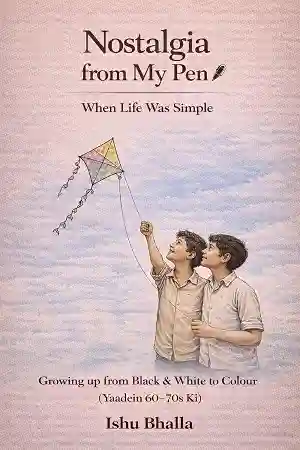
4. The playful glimpses of childhood—kite battles in the gullies, spinning lattu, school-day mischief, and those long exam nights—bring an entire era to life. While writing these chapters, did you ever find yourself smiling or laughing as those vivid memories returned?
Answer: Yes, absolutely. While writing many of those chapters, I often found myself smiling.
Some memories are simply impossible to forget. In those days, every second young girl in the neighbourhood was automatically introduced as “behanhaiteri,” and we were innocent enough to accept that without questioning it. Looking back today, that innocence itself feels quite amusing.
Then there were the funny moments in school — teachers suddenly announcing punishments like “murgabano” or making us do uthak-baithak in front of the whole class. At that time it felt embarrassing, but today those same memories bring a smile to your face.
While writing these stories, I often paused and smiled, wondering what a different and simpler world we were living in.
In many ways, writing these chapters felt like quietly reliving those carefree days again.
5. Your reflections on struggles feel thoughtful and wise, showing how even difficult moments can become meaningful lessons. Were there challenges from your younger years that you now see as quiet teachers in shaping who you became?
Yes, absolutely. Life in those days was very simple. Resources were limited and responsibilities often came early, depending on one’s family circumstances.
Those situations quietly taught many of us important values such as patience, discipline, hard work, honesty and dedication. At that time we may not have realised it, but those lessons became extremely valuable later when we entered our professional lives.
There were not many opportunities or shortcuts available in those days. People had to move forward step by step.
Perhaps that is why many from our generation, even after witnessing the rapid rise of technology and modern lifestyles, still remain deeply rooted in those fundamental values that shaped us during our growing-up years.
6. The language and storytelling in your book feel intimate and genuine, written in simple Hinglish as people naturally speak and remember their experiences, almost like someone sharing memories in a room full of friends. Was it your intention to keep the narrative so simple and heartfelt so readers could feel personally connected to your experiences?
Yes, that was very much intentional.
Right from the beginning, I was very clear that the book had to be written in very simple, everyday language. Hinglish felt like the most natural choice because that is how many of us actually remember and narrate our childhood experiences.
These were simple, innocent and pure memories. I wanted them to come across almost like a relaxed conversation over a cup of tea.
I was never interested in filling the book with complicated language or making it sound like heavy literature. The idea was to keep it honest and relatable.
It is a small 30–40 minute read, and I felt the stories should be told in the same language in which people would naturally share such memories with friends.
Perhaps that is what helps readers feel personally connected to the experiences described in the book.
7. When you reflect on the slower, simpler rhythm of life in the 60s and 70s and compare it with today’s fast-paced, digital world, what do you feel we have gained—and what might we have quietly lost along the way? And on a more personal note, do you still find yourself listening to the radio today, perhaps as a small bridge to those earlier times?
When I look at the difference between those years and today’s world, I feel we have certainly gained many things.
Technology has brought unprecedented connectivity, convenience and access to information. Many aspects of life have become faster and easier, and opportunities today are far greater than what we had during our growing-up years.
But like most things in life, every gain also comes with a small cost.
Somewhere along the way, we may have lost a little of the patience, calmness and depth in human relationships that earlier generations experienced. In those days, people spent more time together physically — conversations happened face to face, and even simple activities created strong emotional bonds.
On a personal note, I still enjoy listening to old songs from the 60s, 70s and 80s on platforms like Saregama or YouTube. Those melodies often act like a small bridge to that earlier time and bring back the warmth of those memories. And if given a chance, I can still watch films like Mughal-e-Azam, Waqt, Anand or Pyaasa any number of times.
Perhaps that is why the nostalgia of those years continues to live quietly within many of us.
8. In your growing-up years, people often coped with challenges through strong family bonds and simple joys. Looking at how people navigate stress and struggle today, what lessons from your generation do you believe could still guide us toward a more balanced and meaningful life?
I would not really see it as a comparison between generations. Every generation lives its life according to the time it belongs to.
The generation that grew up in the 60s and 70s perhaps learnt the art of simple living quite naturally. Resources were limited, so people valued what they had. There was a strong sense of social bonding — family, neighbours and friends were always there for each other, especially during difficult times.
Patience was also something people developed over time. Even small achievements were celebrated. For example, getting a promotion after many years of work or completing long years of service in an organisation was considered a matter of pride and gratitude.
At the same time, I feel today’s generation is remarkably sharp, intelligent and technologically very capable. They are growing up in a completely different world with far greater opportunities.
If there is one area that perhaps deserves a little more attention today, it may be maintaining balance — health, emotional well-being and strong human connections — because these are the things that ultimately help people continue to thrive and grow in the long run.
Also Read: Book Review: ‘Nostalgia From My Pen’ by Ishu Bhalla
9. Many of these stories in the book reflect the warmth of friendships and neighbourhood bonds. Are you still connected with some of your childhood friends today? Would you like to share a few names or a message for that old gang who were part of those beautiful memories?
Yes, very much. The bond with childhood friends still exists even after 55–60 years, and perhaps that itself reflects the strength of that generation.
In those days it was very common for everyone in the group to have amusing nicknames. In our gang too we had names like Papi, Raja, Kukkoo, Bhola, Nikka, Pappu, Pomi, among many others — all of us having grown up in the same locality and the same era.
My message to them today — and it applies to me first as well — would be very simple. At this stage of life we are no longer in competition with each other or anyone else. What matters more is gratitude for everything life has given us and continuing to appreciate each other’s journeys with a smile.
Encouraging and appreciating one another becomes a wonderful tonic to stay motivated and positive in the later years of life as well.
And of course, whenever we meet, the perfect setting would still be a good drink, an old song from Binaca Geet Mala playing in the background… and perhaps the ebook version of Nostalgia From My Pen somewhere on the table. 😃
10. Your book has received encouraging responses from readers and reviews from platforms such as Storizen& The Tribune. Did you expect such reactions when you first began writing these simple memories?
To be very candid, this was something I had never planned. It simply evolved while I was writing small nostalgic chapters and sharing them on Facebook.
What surprised me the most was not the act of writing, but the response that followed. I did not expect much beyond a few kind words, but the encouragement from readers has truly left me humbled.
It touches you deeply when readers describe the book as simple, warm and human — like a gentle conversation over a cup of chai.
I also felt equally grateful when reviewers appreciated the honesty of the writing. In fact, the words used by Storizen touched me deeply when the review said that the book “doesn’t shout its wisdom, it whispers it — and sometimes whispers stay with us longer than noise.”
I am also deeply grateful to The Tribune for featuring the book and appreciating this small attempt.
To all the readers who are discovering the book, I would simply like to say — thank you from the bottom of my heart. I hope the book is read in the same spirit in which it was written.
Read it with a smile. That is what this nostalgia is all about. 😊

Author Bio:
Ishu Bhalla grew up in Delhi during the 1960s and 70s — a time when life moved slower, friendships were simpler, and everyday moments quietly shaped lasting memories.
He later spent over four decades in the corporate world across Delhi, Mumbai, and Chandigarh, working with leading multinational and media organizations.
His first book Nostalgia from My Pen ✍️— When Life Was Simple reflects those early years — not as stories, but as remembered moments of childhood, school days, and neighbourhood life, long before modern technology and constant urgency became part of everyday living.
He believes that some memories — simple and pure — are best shared gently… with a smile and a cup of chai
Books are love!
Get a cop now!