
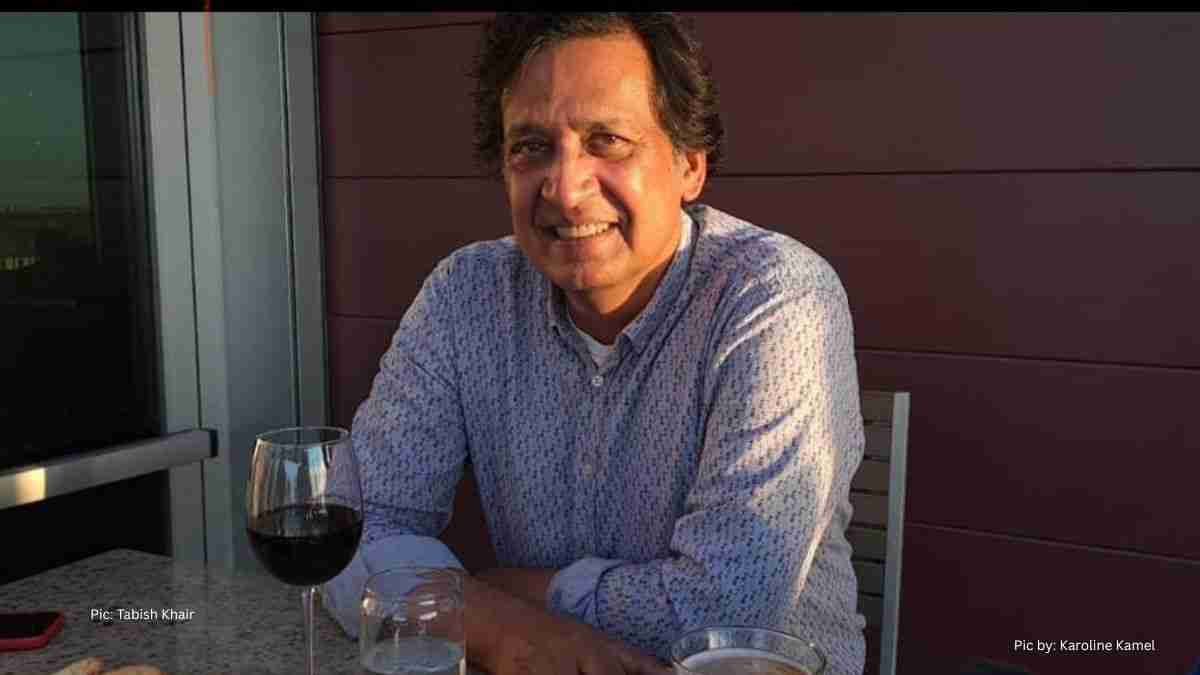
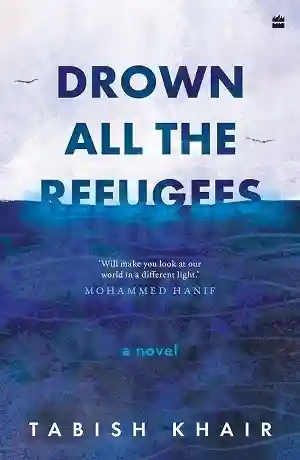
In Drown All the Refugees, acclaimed author Tabish Khair crafts a haunting and thought-provoking narrative that blurs the boundaries between Gothic fiction, political reality, and deeply personal loss. Through a story that confronts migration, displacement, language, and the fragile nature of human connection, the novel challenges readers to move beyond sympathy and confront the uncomfortable truths that shape our world. In this exclusive conversation with Storizen Magazine, Tabish Khair reflects on the creative choices behind the novel, the symbolism of its unforgettable characters, the power of the Gothic form, and why stories about refugees, borders, and belonging have never been more urgent.

1. The novel opens with a shocking outburst at a literary event. What does this moment reveal about your narrator, and why did you choose to begin the story this way?
It is important for me to let the reader know the position from which any narrative proceeds, because I do not believe in transparency and simplistic verisimilitude. Even when we tell our own stories, we are not to be fully trusted, and in order to judge the truths and evasions of a story you need to know who is telling it, from where, why, etc. My opening enabled me to do this – and also reveal the narrator’s character and position, which has to be taken into account too. Then the outburst also served as a hook: Why did he say so? What happens next?
2. Pedro’s return in a changed, almost empty form is deeply unsettling. What does this “return without return” represent in the emotional core of the book?
I think, at least for me, it indicates many things: those who are shadows in our privileged worlds, ranging from the beggar on the street to the children killed in Gaza or Sudan; those whose bodily presence is eroded with new laws or forced displacement, etc. It also indicates what I feel is a growing disjunction between the embodied world and that of mind and money, of which the most recent and perhaps disturbing development, by way of digitalization, is AI (Artificial Intelligence). Then shadows also recall what we have thrust into the dark, and the fact that the dark is perennially linked to our seemingly lighted beings. Light casts shadows.
3. Abdul and Pedro both shape the narrator’s understanding of loss and displacement. How did you decide to structure these relationships within the story?
At first I wanted to set the story in an unnamed space – which could be any country in the world. Because what I narrate is happening in many countries – all ex-colonised countries, but also in sections of ex-colonising nations, like UK, and the currently imperial USA. That is part of the reason there is a story of ‘shadows’ of the dispossessed stalking the hinterland in USA as one of the chapters. But I soon realized that I could not be so broad – or the novel would turn into something like a parable, and lose its historic specificity. So I had to locate it – quite ambiguously – somewhere in the North East of India and send Pedro as an illegal migrant specifically to the ‘West’, maybe Europe, probably USA. But I wanted to ensure the reader would know that I was talking about a matter that afflicts millions across national borders –Abdul, along with those‘shadows’ in the US desert, allowed me to do so. It also enabled me to explore other, more initimate, facets of displacement and loss.
An engagement with difference from a position of mutual evenness. Not pity tossed into the bowl of a beggar from up high above. Not even just empathy, which presumes identification, and can lead to totalitarianism. – Tabish Khair
4. You use gothic horror to explore migration and refugee experiences. What does the Gothic form allow you to express that realism could not?
You will recall that even in the colonial gothic something that has been forgotten and buried in the past erupts into the light of the present, and then it has to be faced – often eliminated, which was a common colonial choice, perhaps the preferred choice from any position of immensely uneven power when faced with difference. I have simply tinkered a bit with the tradition, not turned the ‘gothic secret’ into a monster, but kept its character as a crime that we have committed or allowed to happen. The disposed erupt into our lives of possessions and certainties. Suddenly we are faced with the illegal migrant or refugee we usually encounter only as numbers. But again, I did not want any easy recourse to sympathy or pity for the reader – which was likely in a realist narrative. I wanted something more unsettling. Hence, the restructured gothic was the only effective option to my mind. Not magic realism, as magic realism tends to make the contrasts too rosy-tinged and comfortable for my taste.
5. The novel strongly rejects pity as a response to suffering. What kind of engagement with refugees and displaced people are you hoping to encourage instead?
An engagement with difference from a position of mutual evenness. Not pity tossed into the bowl of a beggar from up high above. Not even just empathy, which presumes identification, and can lead to totalitarianism. Pity and empathy are fine and necessary human attributes. But they are not valid political options – because what we need is an engagement with difference, on all sides, with the realisation that differences will always remain, that the fact of difference is essential to identity and life.
Also Read: Book Review: ‘Drown All the Refugees’ by Tabish Khair
6. Language and power—especially the dominance of English—run through the novel. How do you see language shaping global inequality and whose stories get told?
Despite living in Gaya for the first 25 years of my life, I ended up writing in English. I do read and speak Hindi – and now Danish. My Urdu is fairly OK too, though I can hardly read the script. And when in India I essentially talk what should be called Hindustani. But I write in English. I am very aware of what this means – how I can very easily put words, entire stories, in the mouths of other Indians for instance, either reduce or exaggerate their difference. This consciousness has structured my research, from my PhD thesis which OUP published as Babu Fictions way back in 2000 I think, and my first internationally published work of fiction, The Bus Stopped, that came out around the same time from Picador.I do not want to use my language to evade the issues of power.
7. What drew you personally to write about displacement, refugees, and border-crossing lives at this point in your creative journey?
I have been talking about displacement and belonging etc for a long time now, but my engagement in this direct and vivid form was probably triggered by images of what is happening in Gaza, and our remarkable ability to watch it and go on living. At least the holocaust was partly hidden, and its ravages were mostly revealed only after the Nazis were defeated. But now we have entered a phase of history where everything is visible – and it seems to make no difference. That is also a matter of bodies and shadows, as my novel tries to explore.
Ultimately, Drown All The Refugees is less of a simple narrative and more of an urgent reckoning—a challenge to peer into the shadows our privileged worlds actively cast. By dismantling the comfortable cushions of passive pity and superficial empathy, Tabish Khair forces us to confront displacement not as distant headlines, but as an undeniable shared human truth. In an era where visibility rarely compels action, Khair’s haunting blend of Gothic terror and political reality offers something far more vital: an invitation to look closer, engage deeply, and finally acknowledge the dispossessed on even ground.
Books are love!
Get a copy now!
Are you an author with a powerful story to tell? Pitch your new book to Storizen Magazine for exclusive author interviews, features, and book reviews at talktous@storizen.com.