
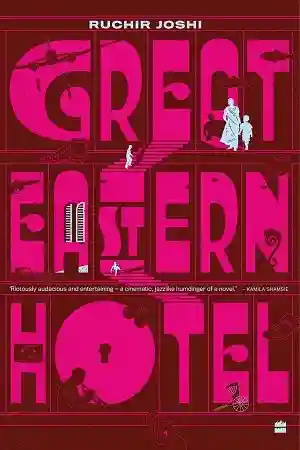
Book Title: Great Eastern Hotel
Author: Ruchir Joshi
Publisher: Fourth Estate India
Number of Pages: 920
ISBN: 978-9365695656
Date Published: Feb. 17, 2024
Price: INR 992
Book Excerpt
Chapter 2
Ascending and Descending
Pg. 162 to 164
For instance, today, in 1977, it’s easy to forget that there are many crimes from thirty–forty years ago for which you can’t blame the Americans. Looking back, there’s a tendency now to segue from the Nazis and the Tojo-Japs straight into the parallel, interlocking hells created by the United States and the Soviets, with Stalin providing a kind of bridge of evil between the 1930s and the 1950s, and then Mao starting another arc just where Stalin’s tapers off. Crawling under this melee of competing villains, the British and the French get to sidle away into the foliage.
Even when I listen back to the Nirupama tapes, so intense is her anger towards the Americans and the Russians, and her bitterness at the Soviets’ different betrayals, that I tend to forget that all that came much later to join her hatred of the Ingrej.
‘I still remember the moment. It was in late October of ’42, after the big cyclone and the Pujas, and Roma and I had come out of Bijoli Cinema, you know the one with the pillars in front with the round lights on top? That one, yes. We had gone for a morning show, but the lights would have been off anyway, even at night, because of the blackout. I can’t remember which film, some Bangla film, obviously, and we were walking down the avenue to the Hazra crossing to catch a tram. It was October, so not yet cold, but even so I wondered why these two women were almost naked. They saw us and started to, I don’t know, sort of stumble towards us with a desperation. It’s not what beggars did, it’s not what beggars do. Normal city beggars, no matter how destitute, would have a sense of where they were, who they were approaching, but not these two women. They were on the road itself, with no awareness of the cars and buses just missing them… Of course, all this I thought about only later, when I thought about it. At the time, I just had the mad idea that these two had dropped from the sky, from some other planet, like one used to read in science fiction stories.
‘They were two women and we were two women, but we had nothing in common. We were two Calcutta girls in pretty good health, and these were two… two… I couldn’t help checking again and again that they were actually women, two human females.’ At this point, Nirupama breaks down into almost sobbing, not something she does very often, and then she controls herself. ‘Their eyes were one thing, huge, almost popping out of the head, and the older one already had a distended stomach. At first, I thought she was pregnant, but then I saw her white hair. Their eyes were one thing, but when the younger one opened her mouth, some strange sounds came out which I could not recognize. Rather, I could almost recognize them as Bangla speech but then again, not quite. Roma was also flummoxed.
‘What did you say? I asked. The woman repeated something. Then Roma asked. Food? Hungry? Then a shopkeeper’s boy passing by started laughing. Arre didi, they are from Comilla, close to where I’m from! They haven’t eaten for a week, that’s what they are saying. Go down towards Kalighat, there are many more of them, all looking for food! They are everywhere, but I haven’t seen anybody else from Comilla.
‘Comilla. You know, geographically it’s two hundred and fifty miles east from Calcutta, but those two hundred and fifty miles are all river delta, so you have to double that, and then… the two-fifty miles of those days are very different from the two-fifty miles of today, you understand?’
I nodded.
‘So… how do these two starving village women from Comilla get to Calcutta in 1942? If you’re from Comilla, why not head for Dhaka, a city which is right there? But we never asked them, because it was not possible to ask. You just knew they didn’t have too many days left in their bodies. Roma and I pulled out whatever money we had, a rupee and a few annas, keeping back just enough for the tram fare, and gave it to them. We had to make sure the younger one didn’t drop the money, Roma made sure she closed the girl’s fingers around the coins, and then, and then… I’m ashamed to say, Communist Niru and Congress Socialist Roma, we almost ran to the tram. When we got home, I realized that such had been my panic I had scratched myself badly while reaching into my blouse.
Check out our Latest Book Reviews
‘By the end of 1942, reports from the villages had already started coming in via the Party cadres, but everybody thought this was just – what was the sentence? – “Just another temporary intensification of long ongoing peasant misery.” It was when they appeared on the streets, these skeletons whispering in dialects we rarely heard in Calcutta, that the horror became clear. As I said, you could tell they were different from city beggars. They didn’t know their way around. You could almost see every big building, every wide avenue sparking a new fear in their eyes. Speaking in tongues we could only vaguely connect to the Bangla we knew. A few days after that encounter near Bijoli, around Shyambajar I again heard very different accents, which I later understood were from Mednipur and Purulia, all the way in the west. It was as if all of Bengal was arriving to collect their dues from Calcutta.
‘I took a while to realize this is what the British had done to us, them and the black marketeers, the middlemen who were – and in the Party study groups, we were taught never to forget this – very much Indian. Marwaris, Bhaiyas and Bengalis. Both Hindus and Muslims, and very much Indians.’
That was in 1943, but at the moment I’m looking at the end of November 1941.
Sometimes, the more you tidy the messier it gets.
Excerpted with permission from Great Eastern Hotel by Ruchir Joshi published by Fourth Estate India.
Books are love!
Get a copy now!