
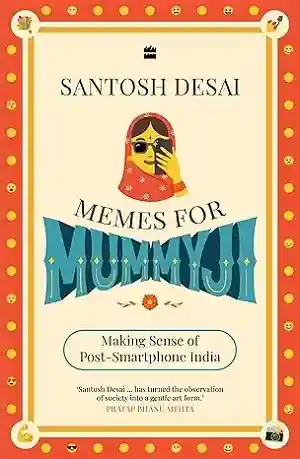
Book Title: Memes For Mummyji: Making Sense of Post-Smartphone India
Author: Santosh Desai
Publisher: HarperCollins India
Number of Pages: 400
ISBN: 978-9371977869
Date Published: Nov. 27, 2025
Price: INR 470
Book Excerpt
CHAPTER 1
Digital Culture: Our Performing Selves
Pages 3-5
LADDERS TO ELSEWHERE: OF MOBILE PHONES AND SMALL-TOWN INDIA
THE FADED WALL PAINTING IN Raipur is for an event management company called Crazy Chaps. Only one part has been repainted, the only bit that matters – the mobile phone number. In a small but telling way, it speaks of the centrality of the mobile phone in India; it is as if almost every aspect of one’s identity can somehow be encapsulated in this tiny device.
Everywhere one travels in small-town India, one finds the powerful influence of this sliver of technology. Indeed, there are times when, if one were to freeze-frame on a random scene, every single person in it would be doing something with a phone. Mobile phone usage has settled over small-town India like a coating of access, creating intricate new networks of communication while also serving as part rabbit hole into the self and part ejection hatch into an outside world full of nameless opportunity. The small town reaches beyond itself, and suddenly everything is within grasp.
For many, perhaps the most profound way in which it has changed them begins with the act of owning a mobile phone itself. To get a unique number, and with it the ability to reach anyone with a phone and, in turn, be reached by anyone, gives one an address in the new world. The mobile phone is a giant act of inclusion and an assertion of the significance of the individual as she becomes part of a network of possibilities, a citizen of a new collective.
The conferment of identity in a way that could be tangibly experienced has perhaps been the most important contribution made by this increasingly versatile device. Across the country, in so many different ways, the mobile phone is making the individual experience herself as a brighter dot on the map of the world. The self is being experienced both as being connected to the larger collective as well as separate from it. The ability to stay connected deepens ties between loved ones even as it allows for greater physical separation. The mobile phone is altering the constraints imposed by geography and migration and making it possible for many more people to imagine distance as a variable that can be managed.
The difference is most significant in the case of young women, many of whom report that their desire to move to another town to study is easier to convert into reality thanks to the mobile phone. The ability to access someone and, in turn, be accessed in private is something that creates both personal possibility as well as a kind of social anxiety. For old power structures don’t get dismantled that easily.
The ability of the mobile phone to unleash a new set of desires among women is the reason why it comes under the greatest scrutiny. It is common to hear laments about the changing values that get attributed to the use of mobile phones by women, and in some parts of India, there is an active policing of its use. Worse, it enables old patriarchal attitudes to find new instruments of abuse, with multiple examples of exploitative MMSes, deepfakes, instances of revenge porn and the circulation of rape videos becoming commonplace.
The ability to stay connected is also making for some interesting new kinds of codes in relationships. For a lot of young people, the idea of a private channel of communication that is invisible and continuous enables a new meaning of romance. In many small towns across India, including the north, where the intermingling of the sexes is actively managed, the mobile phone becomes a vehicle of building and breaking relationships. For boys, the phone encourages risk-taking – try maar lo, kya jaata hai, as one young man put it. The idea of couples is becoming more commonplace, but interestingly, very often this does not necessarily culminate in marriage, nor is it intended to. It is conceived of as a device to intensify the enjoyment of youth, before submitting to the responsibilities of adulthood.
For people in relationships, the mobile phone allows for privacy but also creates a new set of expectations. Continuous contact is expected and its absence can create difficulties in some relationships. Being in love now comes with a currency of attention, and unless a steady stream of calls and messages flows, one isn’t proving one’s affections enough.
The mobile phone, by its nature, allows for the existence of a parallel script to life. The ability to be somewhere else also translates into being able to be someone else simultaneously. People manage multiple lives more easily with the mobile phone. Like the temple-sevak-cum-dancer-cum-event- manager-cum-TV-actor in Konark, who uses the mobile phone to juggle parallel careers as well as play doting husband and father. Or the wrestling-champion-turned-bouncer in Gurugram, who navigates two completely different cultural universes. On one hand, he lives and abides by the strict code of behaviour imposed on him by his guru, and on the other, poses shirtless for his Facebook profile. Or yet another very enterprising young boy from Rajkot, who claims that he needs a phone with multiple SIM cards – multiple SIMs for multiple girlfriends, as he put it. In a world where opportunities are several but mostly fragmented, the mobile phone allows for these to be reconciled and availed of.
Check out our Latest Book Reviews
Excerpted with permission from Memes for Mummyji by Santosh Desai, published by HarperCollins India.
Get a copy now!