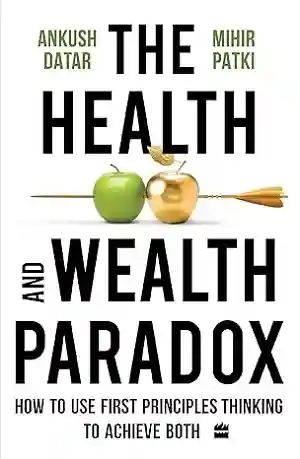
Book Title: The Health and Wealth Paradox: How to Use First Principles Thinking to Achieve Both
Author: Ankush Datar and Mihir Patki
Publisher: HarperBusiness
Number of Pages: 256
ISBN: 978-9365695571
Date Published: Dec. 15, 2024
Price: INR 258
Book Excerpt
Chapter 1
Your Plan Is Your North Star
Pg. 3 to 6
First Principles of Nutrition
These are very basic parameters we wish were taught at an early age. But, as with almost all human beings, we were forced to learn them due to circumstances. Nutrients come in two broad categories—macronutrients and micronutrients. Macronutrients consist of carbohydrates, proteins and fats, known together as ‘CPF’.
Micronutrients, meanwhile, consist of vitamins and minerals, which are essential for the overall health and well-being of the body. They are taken in relatively small quantities but play crucial roles in various physiological functions—for example, vitamins A, B-complex, C, D, E and K are necessary for functions such as vision, immune support, energy metabolism and bone health.
Micronutrients are typically obtained from within macronutrients, or through supplementation when food is not doing the job.
We will cover the basic principles of macronutrients. Micronutrients usually fall in place if you are getting your macronutrients from natural sources.
Carbohydrates
Think of these as the main fuel-storage source of the body. If we are going for a long run or intense exercise and activity, you will need to fuel the tank accordingly for that particular activity—be it a long-distance run or a heavy workout, or to refuel a depleted tank.
Proteins
These are the building blocks of our body and are arguably the most important piece in the macronutrient puzzle. They are vital for strengthening our bones, organs, hormones, enzymes and more. They even have a secondary role of acting as energy storage for the proverbial ‘rainy day’.
Fats
These are the most important store of energy in our bodies, and no, they don’t make us ‘fat’. Dietary fat is different from body fat. They serve as transport mechanisms for vital nutrients across the body, and are also responsible for regular hormonal functions.
Check out our Latest Book Reviews
What Are Calories?
A calorie is a measure of the energy content of food. In scientific terms, it is defined as the amount of heat required to raise the temperature of one kilogram of water by one degree Celsius.
Every gram of carbohydrate contains 4 calories; every gram of protein contains 4 calories, and every gram of fat contains 9 calories.
So, how many calories should one consume and what is the best allocation between CPF?
This can be broken down in simple terms, but let us first understand some basic terminology.
Basal Metabolic Rate (BMR)
This is the minimum amount of energy required to sustain the basic physiological functions of the body, including breathing, circulation, maintaining body temperature, and other metabolic processes. The BMR represents the energy the body consumes at rest, in a post-absorptive state (when a person has not eaten for at least 12 hours), and in a thermoneutral environment (comfortable room temperature).
It accounts for approximately 60–70 per cent of the total energy expenditure of an individual. The BMR can vary based on factors such as age, gender, body composition and genetics. Generally, larger individuals and those with more muscle mass (not just large body fat) have higher BMRs than smaller individuals with less muscle mass.
Knowing one’s BMR can be useful in determining the daily caloric needs required to maintain, gain or lose weight.
Thermic Effect of Food (TEF)
Every food in the CPF categories uses energy to be digested. The TEF is the number of calories the body burns in digesting and absorbing nutrients from food. The body uses the most energy to break down proteins. Dietary fats also require more energy to digest. Carbohydrates are easily digested and require less energy to process, making them less satiating compared to the same quantities of protein and fat.
However, we know by now that each macronutrient has its place. This is one of the key reasons why ‘protein-rich diet’ is a term we often hear in the context of people trying to lose weight.
Non-exercise-Activity-Thermogenesis (NEAT)
This is the movement of the body in non-exercise form. It is part of the calories we burn outside our actual workout. Those 10,000 steps of walking, going to the washroom, going to the kitchen to grab a meal—all these activities burn calories too, and are as important in active calories burnt as the next component, EAT.
Exercise-Activity Thermogenesis (EAT)
These are the number of active calories we burn during a workout.
| Activity | Calories burnt in 1 hour of activity |
| Strength training | 606 calories at a moderate pace |
| Walking | 224 calories for a person weighing 70 kg |
| Running | 314 calories at a moderate pace |
These are broad numbers; calories burnt could vary based on metabolism and other factors. The intensity of the workout could also cause fluctuations in calorie burn.
However, this does not imply that one should pursue activities solely based on their calorie-burning potential. Strength training is arguably the most important activity. We will delve deeper into this in a later chapter, and generally express our preference for it.
Excerpted with permission from The Health and Wealth Paradox by Ankush Datar and Mihir Patki published by HarperBusiness.
Books are love!
Get a copy now!