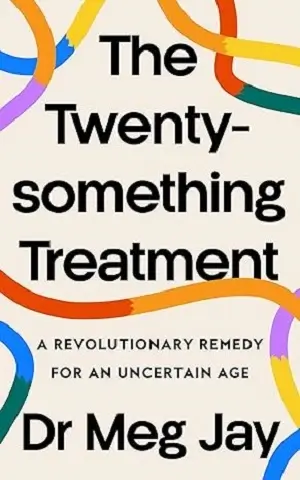
Book Title: The Twentysomething Treatment
Author: Dr Meg Jay
Publisher: Fourth Estate
Number of Pages: 288
ISBN: 978-0008713881
Date Published: Apr. 25, 2024
Price: INR 380
Book Excerpt
Chapter 1
An Uncertain Age
There is a remarkable human capacity to adapt to both prosperity and adversity. One thing people do have a hard time adapting to is
uncertainty.
—Carol Graham, The Economist
“My psychiatrist told me to talk to you,” Irene began, already breathless.
“He thinks I have, like, social anxiety or I don’t know what. I told him I haven’t been wanting to see people as much as I used to, like before the pandemic. I have to make myself text people—I hate it when they don’t text me right back; I worry they’re thinking something bad—and I have to make myself go out. Then when I get there, I have an okay time, but when I get home, I can’t sleep. I already take sleep meds sometimes, so my doctor thinks maybe I need some other anxiety meds, too. It’s just that I’m having all these irrational thoughts. Crazy thoughts. Like when I’m supposed to be sleeping. It’s 2:00 a.m. and my brain just keeps seeing what it can come up with to worry about or feel sad about. Like, what am I going to do if my parents pass away? I’m worried because they’re getting older, and I moved across the country for this new job, and I don’t know when I’ll settle back on the West Coast again. What if I didn’t do the right thing coming here?
And I dragged my partner along! I mean, I’m about to turn thirty, and time is passing. Things are getting real. My number one goal in life is to have a routine, so maybe this job will give me that. There has just been so much limbo. I don’t have a lot of knowns in my life. There
aren’t a lot of facts.
“Sometimes on the weekend, I feel so overwhelmed by everything that still has to happen somehow that I’ll spend all day in bed or all day
watching TV, like I’m depressed or something. Then at night, there’s so much, I don’t know, uncertainty. I just toss and turn and worry about whether my job is going to work out . . . whether my relationship is going to work . . . whether I should be freezing my eggs or something. Then, I get worried about not sleeping, and I pace around, and I wonder if have some sleep disorder and, like, if I’ll ever be able to sleep again. That’s when I decide to finally take my chill pills—you know, my sleep meds—so I can finally chill out and go to sleep.”
In 1789, Benjamin Franklin famously said that nothing is certain except for death and taxes. While most people take this as a comment on, well, death and taxes, Franklin was pointing out that uncertainty has always been and will always be a big part of life.
Franklin wrote these words to scientist and friend Jean-Baptiste Le Roy, who was enduring the throes of the French Revolution. “It is now more than a year since I have heard from you. What can be the reason?
Are you still living? Or have the mob of Paris mistaken the head of a monopolizer of knowledge, for a monopolizer of corn, and paraded it about the streets on a pole,” Franklin inquires in his letter before suggesting that his fledgling country, the United States, was also no sure thing. “Our new Constitution is now established, and has an appearance that promises permanency; but in this world, nothing can be said to be certain, except death and taxes.”
Check out our Latest Book Reviews
So, in the history of civilization, uncertainty isn’t new, but it is new for twentysomethings. Year after year, generation after generation, a new crop of young adults—those whose lives were once scheduled and structured by school—graduate into their twenties and into the great unknown. Before that, there were syllabi that told them exactly what to do and when to do it. There were grades that quantified where they stood and how they stacked up against their peers. There were yearly advancements that signified clear progress and an upward trend.
Then, sometime around age 20, young adults trade a lifetime of school for the new world of work—or they try to—and they see nothing but uncertainty all around them. Today’s young workers will have, on average, nine different jobs by the age of 35. That’s right: nine. Along the way, about half of young adults receive financial help from their parents, and about a fifth have bills that are unpaid and overdue. About a quarter of twentysomethings move each year, often to follow a job or to look for a better one. Meanwhile, about a third of workers now work from home, which for many twentysomethings is an overcrowded apartment with paper-thin walls. Sure, a fortunate few young adults may be globe-trotting digital nomads but for most, working remotely means migrating from coffee shop to coffee shop, with laptops and chargers in tow.
As coffee shops and jobs and cities and apartments come and go, friendships and relationships do, too. That’s why, although we may think
of our twenties as an incredibly social time, they are in fact the loneliest years of all. About two-thirds of twentysomethings say they have no close friends; about half of twentysomething men and a third of twentysomething women are single, although about half of the unattached say they want more in friendship or love.
The percentage of young adults who will eventually marry is on its way down, however, and for those who choose to tie the knot, the average age to say “I do” is on its way up. Thirty is now the mean-average age to walk down the aisle or to stop by the courthouse, and it’s also the median average age to have one’s first child. As families and careers and salaries are likely not established until one’s thirties, the average age of a first-time home buyer is at an all-time high of 36 years old. Still, because housing inventory is low and prices are high, owning a place of one’s own can feel more like a fantasy than a part of the American Dream.
Twentieth-century twentysomethings were likely to wake up to a spouse, a career, a baby, and maybe even a home and a purpose. These days, such sources of stability are more likely to be realized in one’s thirties and beyond—if at all. For many reasons, twenty-first-century young adults, like Irene, settle down later than earlier generations used to, which means that they’re likely to spend the first decade or so of adulthood feeling unsettled. And it’s not just young adult lives that are unsettled; the era in which they live is unsettling, too.
Today’s twentysomethings grew up in the shadow of 9⁄11 and the threat of terror raining down on a sunny day. They went to classes amid
more than 375 school shootings—and counting—since the year 2000. Hundreds of thousands of them have been exposed to gun violence, and nearly all of them know what it is like to crouch under their desks in an active-shooter drill. From there, they’ve moved on to the workplace, which may feel no safer. Work is the most common site for mass shootings, as well as where roughly 50 percent of women and 25 percent of men may one day say “Me, Too.”
Walking down the street amid cries that “Black Lives Matter,” some feel overwhelmed by the racial, social, and economic inequality they see on every corner. Going out in the evening after a reversal of Roe v. Wade, others feel they have lost control of their bodies and their choices. Watching politicians attack each other in the news, still others feel like children in a home with warring parents as they brace themselves for a national divorce. Coming of age during a pandemic, nearly all wonder if some of their best years and greatest opportunities were lost to lockdowns. And trying to envision a future under the cloud of climate change, many question whether they should bother at all to think ahead.
Every decade of life is difficult, but for twentysomethings, uncertainty is the most difficult part of all. According to Google, the word uncertainty was used in the English language at a rather steady rate until about the year 1950. From then on, it crept upward to a peak at around the year 2000, where it has remained ever since. Indeed, twenty-first- century twentysomethings, like Irene, are living with peak uncertainty in almost every way, and this has an indisputable, but vastly underrecognized, impact on their bodies and their brains.
Excerpted with permission from The Twentysomething Treatment, written by Dr. Meg Jay, and Fourth Estate.
Get a copy now!