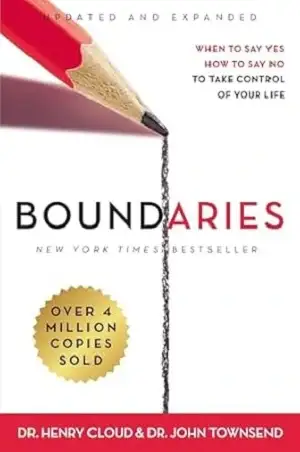
Book Title: Boundaries Updated and Expanded Edition(Enlarged): When to Say Yes, How to Say No To Take Control of Your Life
Author(s): Dr. Henry Cloud and Dr. John Townsend
Publisher: Zondervan
Number of Pages: 352
ISBN: 978-0310370536
Date Published: Nov. 30, 2024
Price: INR 369
Book Review
Originally published over thirty years ago, “Boundaries” by Dr. Henry Cloud and Dr. John Townsend has had a significant cultural impact, selling millions of copies and spawning resources for various life areas like relationships, parenting, and work. The book is structured into three parts: defining boundaries and their guiding laws, applying these principles across life domains, and developing healthier boundaries.
The authors present boundaries as “personal property lines” that define one’s identity and interactions. While the book’s intentions are commendable, it elevates boundaries as the key to fulfillment, which some argue overshadows deeper spiritual truths and the gospel’s transformative power.
The book offers practical guidance, particularly for individuals struggling with people-pleasing tendencies or the unsustainable pressure of constant availability. The authors draw upon years of counseling experience to illustrate their points, providing relatable examples. Chapter 4 stands out for its valuable advice, such as cautioning parents against overcontrolling or relying on children for emotional support.
Additionally, Boundaries acknowledges the importance of biblical wisdom and community, recognizing the local church as a helpful resource for navigating relational challenges. These strengths make the book accessible and potentially beneficial for readers seeking tools to address interpersonal struggles.
Check out our Latest Book Reviews
Despite its merits, the book’s application of boundaries as a universal framework becomes problematic, especially when extended to theological contexts. The authors propose that God respects human boundaries, citing examples like the prodigal son and the rich young ruler. However, this interpretation often misses the deeper spiritual implications of such stories. Critics argue that the concept of boundaries, while useful in human relationships, cannot fully encompass the complexities of divine interaction or Scripture’s broader teachings. The book risks oversimplifying nuanced spiritual and relational dynamics by framing boundaries as a central lens for interpreting relationships and Scripture.
While Boundaries provides helpful tools for managing relationships and setting limits, its overemphasis on the concept detracts from the centrality of wise, discerning love rooted in Scripture. The authors’ “Boundaries” offer practical advice but fall short of addressing the deeper, individualized discernment required for navigating broken relationships. True relational healing often requires divine intervention and an approach that prioritizes love and communion with God over rigid frameworks. For readers seeking a biblically grounded approach to relationships, the book may serve as a starting point but lacks the depth to be a comprehensive guide.
Books are love!
Get a copy now!