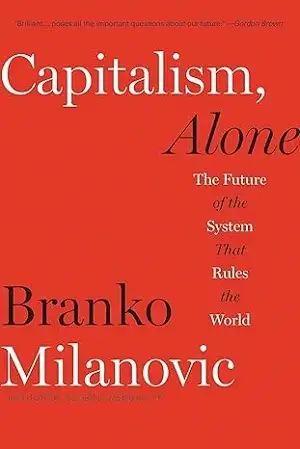
Book Title: Capitalism, Alone: The Future of the System That Rules the World
Author: Branko Milanovic
Publisher: The Belknap Press
Number of Pages: 304
ISBN: 978-0674260306
Date Published: Oct. 15, 2021
Price: INR 1,866
Book Review
Branko Milanovic’s “Capitalism, Alone” offers a thorough analysis of capitalism as the dominant socio-economic system in today’s world. The book explores the historical shifts that have led to capitalism’s global dominance and delves into the two primary variants of capitalism that now vie for global leadership: liberal meritocratic capitalism and political (authoritarian) capitalism.
Milanovic identifies capitalism as the sole surviving economic system, having outlasted alternatives like feudalism and communism. He categorizes capitalism into two main forms: liberal meritocratic capitalism, represented by the United States, and political capitalism, exemplified by China. While liberal meritocratic capitalism emphasizes equality of opportunity, it still perpetuates inequality, as the wealthy can pass on their advantages to their offspring. In contrast, political capitalism, despite its efficient bureaucracy, is plagued by a lack of rule of law and inherent corruption.
The book is praised for its intellectual depth, providing a sweeping overview of economic and social history. Milanovic’s classification of different capitalist systems is considered a significant contribution to the understanding of global economics. However, the book faces criticism for its limited focus on environmental issues and its brevity in addressing solutions to the challenges it discusses. Additionally, Milanovic’s perspective on the historical role of communism is seen as unconventional by some readers.
Check out our Latest Book Reviews
Milanovic’s analysis of the two main variants of capitalism—liberal meritocratic capitalism and political capitalism—reveals key differences in their approaches to governance, economic control, and inequality. While liberal capitalism allows for more democratic input and rule of law, it still drives up inequalities. Political capitalism, with its greater state control and efficiency, suffers from corruption due to its lack of autonomy and rule of law. Despite these differences, both systems remain fundamentally capitalist, with private ownership of capital and production geared towards markets.
“Capitalism, Alone” is a thought-provoking and comprehensive examination of the dominance of capitalism and its future prospects. Milanovic’s exploration of the varieties of capitalism provides valuable insights into the challenges and potential paths forward for the global economy. While the book is not without its flaws, it offers an important contribution to the ongoing debate about the future of capitalism and the possibility of a more equitable system emerging in the years to come.
Books are love!
Get a copy now!