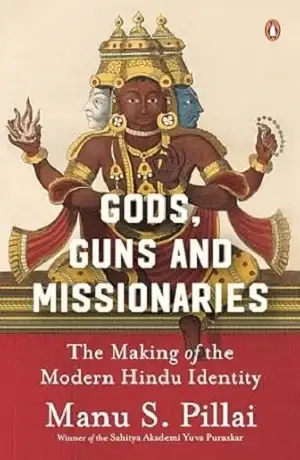
Book Title: Gods Guns & Missionaries: The Making of The Modern Hindu Identity
Author: Manu S. Pillai
Publisher: Penguin Random House India
Number of Pages: 664
ISBN: 978-0670093656
Date Published: Nov. 21, 2024
Price: INR 672
Book Review
Manu S. Pillai’s recent book, “Gods Guns & Missionaries: The Making of The Modern Hindu Identity” takes readers on a fascinating journey through the history of Hinduism’s transformation during colonial rule. The book explores how Hinduism, known for its flexibility and diversity, was reshaped under the influence of European missionaries and British imperialism. With a rich cast of characters, including poets, philosophers, reformers, and revolutionaries, Pillai examines the social and political forces that helped shape modern Hindu identity. The book opens with the intriguing account of Jaipur maharajah’s 1902 journey to England, complete with rituals and symbols of orthodoxy, setting the tone for a richly detailed exploration of India’s evolving religious and cultural identity.
The book highlights the challenges Hinduism faced when early missionaries, such as Portuguese Jesuits, dismissed it as a superstitious and chaotic faith. Over time, Orientalists like William Jones sought to celebrate its philosophical depth, but even they reduced Hinduism to simplified ideas. Reformers like Raja Ram Mohan Roy and Dayananda Saraswati responded by reimagining Hinduism to defend it against colonial critiques. They often focused on texts like the Upanishads, portraying them as the “true” essence of Hinduism, while downplaying the rich myths and rituals found in the Puranas.
Check out our Latest Book Reviews
Author Pillai shows how colonialism forced Hindu thinkers to adapt and redefine their traditions. While this helped Hinduism survive in a changing world, it also led to a narrowing of its vast, vibrant character. The flexibility that once allowed Hinduism to absorb diverse practices was replaced by a more rigid structure, shaped by Western ideas of religion. Yet, he doesn’t reduce this process to a negative outcome. Instead, he presents it as a story of resilience and reinvention, showing how Hinduism navigated external pressures to emerge with new strength.
The book focuses on India’s cultural and religious expressions, capturing the fluid and shifting nature of beliefs with exceptional clarity. His methodical approach, sensitivity to nuance, and deep understanding of semiotics allow him to analyze Indian ideas and traditions with remarkable precision is interesting. Covering a wide span of history—from Akbar’s interactions with Jesuits to Savarkar’s death the book showcases great stories that combine meticulous research with insightful details. To add to this, photographs add beauty to the book. “Gods Guns & Missionaries” is a thought-provoking and accessible read, offering a fresh perspective on a complex and evolving tradition.
Books are love!
Get a copy now!