Book Title: Jahanara: A Novel
Author: Sukumaran
Translator: Kalaivani Karunakaran
Publisher: Eka
Number of Pages: 204
ISBN: 978-9360457686
Date Published: Sept. 23, 2024
Price: INR 285
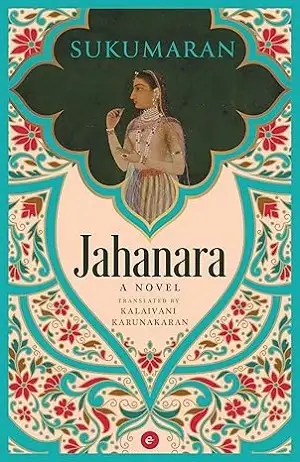
Book Review
Tamil author Sukumaran’s novel “Jahanara: A Novel” brings to life this remarkable woman’s untold story, drawing on the diaries she kept during her lonely years in the Mughal court. Through Panipat’s perspective, Sukumaran vividly portrays Jahanara’s internal struggles, her intellect, and the emotional toll of her family’s political conflicts. This novel stands out in Tamil literature as a powerful tribute to a princess whose legacy extends far beyond her role in Mughal history.
Jahanara Begum, the eldest daughter of Mughal Emperor Shah Jahan, was a powerful figure known for her political influence and artistic achievements. She supported her brother Dara Shikoh during the succession war and played a key role in court politics. As a talented architect, she designed landmarks like the Jama Masjid and authored works including a biography of Sheikh Mu’in ad’-Din Chishti. Despite her successes, her personal life was marked by emotional struggles, including unfulfilled love for Rajput king Chattar Sal and isolation in the royal court. Her legacy continued under Aurangzeb, who honored her with the title “Empress of Princesses.”
In this captivating book by Sukumaran, translated into English by Kalaivani Karunakaran, Jahanara Begum, the eldest daughter of Mughal Emperor Shah Jahan, is portrayed as one of the most knowledgeable and politically savvy princesses in Mughal history. As a young girl, she offered her father insightful advice on state matters and diplomacy, skillfully navigating the intricate world of court politics. Jahanara played a pivotal role in mending the strained relationships between her father and her brothers, Dara Shikoh and Aurangzeb, all while deftly countering the manipulative schemes of her stepmother, Noor Mahal. With fluency in Persian, Sanskrit, and other languages, her intellectual curiosity also led her to explore the Quran, Vedas, and Puranas, establishing her as a true scholar of her era.
Check out our Latest Book Reviews
This book stands out in its unique approach, divided into two captivating parts: ‘Panipat’ and ‘Jahanara.’ In the first part, Panipat serves as a character who engages directly with the readers, sharing insights about Akbar’s regime and Jahanara’s story from its perspective. The author skillfully takes the liberty to explore this narrative through the lens of a genderless being, shedding light on a story that many have overlooked. The second part is titled as Jahanara and the story runs in her voice.
Despite her political and intellectual prowess, Jahanara’s personal life was marked by great emotional turmoil. Forbidden by her grandfather Emperor Akbar’s decree from marrying or taking lovers, she was forced to suppress her deep love for the Rajput king Chattar Sal. Her life was one of isolation, devoted to caring for her father and seeking companionship in her friendship with a eunuch named Panipat. The constraints of Mughal tradition stifled her personal freedom, forcing her to find solace in writing and self-reflection.
While many authors in India often focus on women from Hindu and Greek mythology, choosing a Mughal woman like Jahanara Begum—who played a significant role in India’s history—makes for a unique and refreshing narrative. This fascinating and realistic portrayal offers a fresh perspective, making it a compelling read for history enthusiasts. A wonderful attempt that stands out in historical fiction!
Books are love!
Get a copy now!