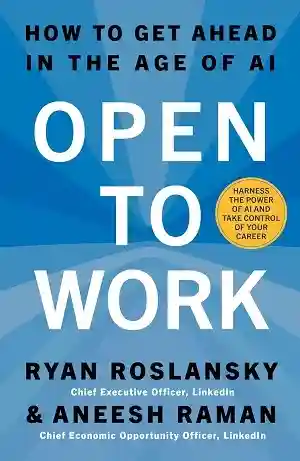
Book Title: Open to Work: How to Get Ahead in the Age of AI
Author: Ryan Roslansky and Aneesh Raman
Publisher: HarperCollins
Number of Pages: 288
ISBN: 0008770662
Date Published: Mar. 31, 2026
Book Review
“Open to Work: How to Get Ahead in the Age of AI” by Ryan Roslansky and Aneesh Raman is a helpful and timely guide for anyone worried about how artificial intelligence (AI) will affect their career. Instead of focusing on fears that AI will take away jobs, the authors explain that AI is changing the workplace faster than ever. Skills become outdated more quickly, jobs change more often, and the biggest risk is not keeping up. Using data from LinkedIn’s huge global network, Roslansky, LinkedIn’s CEO, and Raman provide practical advice based on real workplace trends rather than guesses about the future.
The main idea of the book is that the world is moving from a system based on job titles to one based on skills. The authors believe that being able to learn and adapt is now more important than holding a specific position. They argue that AI is not replacing people completely but changing how people create value. Human qualities such as creativity, curiosity, communication, and problem-solving are becoming even more important because AI can already handle many routine tasks like research, summaries, and data analysis.
One of the most useful parts of the book is its advice on working with AI. Instead of thinking about a job as a single role, readers are encouraged to break it down into individual tasks. These tasks can then be divided into three groups: tasks AI can do on its own, tasks that people can do together with AI, and tasks that still require human skills. The authors also introduce a practical “30-60-90 Day AI Plan” that helps readers gradually learn how to use AI effectively and decide which parts of their work they should automate and which parts they should focus on themselves.
Check out our latest Book Reviews
Overall, “Open to Work” feels like advice from a supportive mentor. The writing is clear, practical, and easy to follow, making the changes brought by AI less intimidating. While the authors understand why people are worried about AI, they believe fear is not helpful. Instead, they encourage readers to focus on the opportunities AI creates. For anyone wondering about the future of their job, career, business, or community, this book offers a positive and realistic guide to understanding what AI will change, what it will not change, and how people can use their unique strengths to succeed.
Books are love!
Get a copy now!