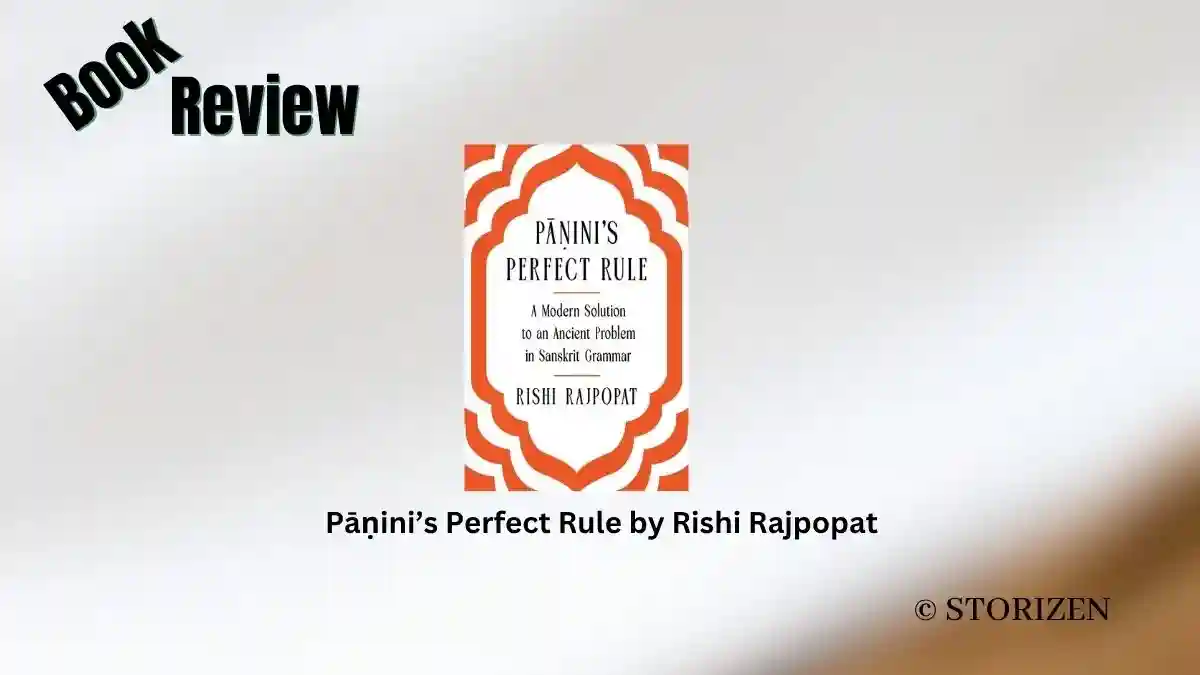
Book Title: Pāṇini’s Perfect Rule: A Modern Solution to an Ancient Problem in Sanskrit Grammar
Author: Rishi Rajpopat
Publisher: Harvard University Press
Number of Pages: 296
ISBN: 0674305760
Date Published: Dec. 16, 2025
Price: INR 514 / $45

Book Review
An argument that Sanskrit is considered an ideal language for computer science, particularly in artificial intelligence (AI) and natural language processing (NLP), due to its highly structured, logical, and rule-bound grammar (Pāṇini’s grammar), which minimizes ambiguity. While not a programming language itself, its precise syntax resembles algorithms is always debatable. The strict grammatical rules of Sanskrit mean it is context-free, making it highly effective for machine parsing and AI, and this statement is often taken into account.
To understand more about the argument, Rishi Rajpopat’s insightful book, “Pāṇini’s Perfect Rule,” addresses a long-standing debate among linguists regarding the mechanical generation of language and specifically re-evaluates the efficacy of Panini’s grammar, which consists of 4,000 rules designed to construct Sanskrit forms. Historically, mastering Panini’s rules necessitated understanding an extensive array of commentaries that introduced complexities and exceptions, leading to inconsistencies in sentence formation. Rajpopat’s 2022 thesis challenges this by positing that Panini’s core principle, “in case of conflict, choose the latter,” actually pertains to the latter of two conflicting elements, not merely a sequential rule. This interpretation leads to a straightforward application of Panini’s rules, yielding correct outputs devoid of additional metarules.
The author likens his findings to a Copernican revolution in grammar, highlighting how prior approaches resembled misguided Ptolemaic models, complicating rather than clarifying the process of language formation. His method illustrates using a computer simulation of Panini’s rules to generate proper morphological forms from given Sanskrit roots, emphasizing specific rules to resolve conflicts.
The discussion extends to the nature of Panini’s grammar, which, unlike the simple syntactic structure of languages like English, involves complex morphological adjustments. Through examples, such as transforming “deva” into the plural “devā” for grammatical correctness, Rajpopat illustrates how Panini’s framework can produce accurate outputs while acknowledging some limitations in addressing all forms presented in earlier Sanskrit texts like the Vedas.
Despite its scholarly rigor, the book’s use of traditional Sanskrit terminology poses challenges even for advanced readers, as it contains extensive proofs supporting Rajpopat’s thesis, which may only appeal to those studying Sanskrit. Overall, “Pāṇini’s Perfect Rule” enriches appreciation for both Panini’s grammatical innovations and Rajpopat’s transformative insights into how they function, highlighting the extent of Panini’s legacy in linguistic science.
Books are love!
Get a copy now!
Also Read: