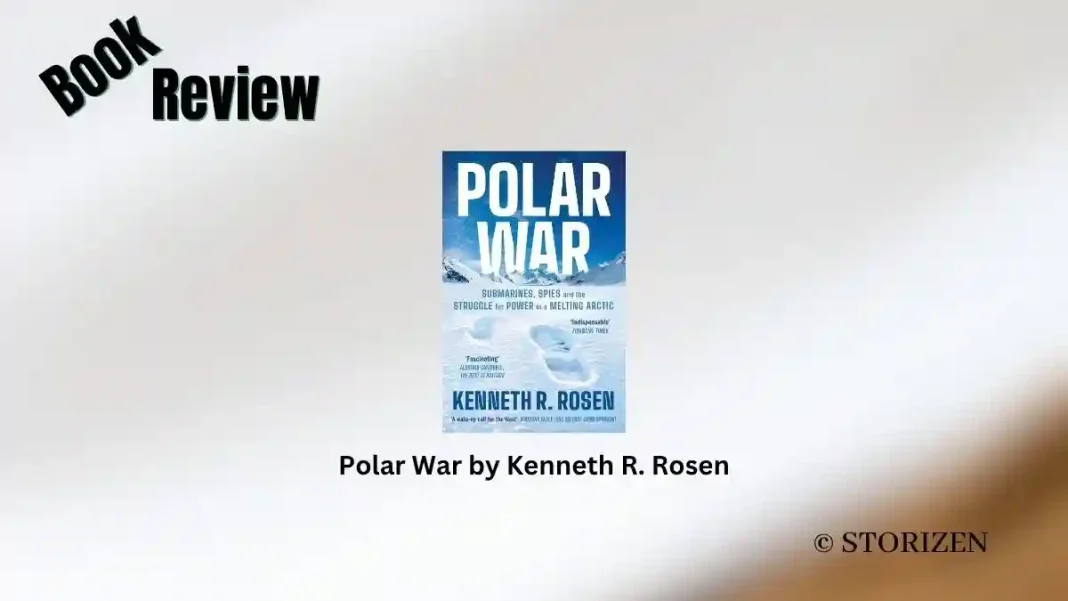
Book Title: Polar War: Submarines, Spies and the Struggle for Power in a Melting Arctic
Author: Kenneth R. Rosen
Publisher: Profile Books
Number of Pages: 320
ISBN: 1805229125
Date Published: Jan. 22, 2026

Book Review
“Polar War: Submarines, Spies and the Struggle for Power in a Melting Arctic” by Kenneth R. Rosen is more of a harrowing report from the front lines of a warming, militarized earth than a traditional military history. Rosen combines travelogue, firsthand reporting, and geopolitical analysis to demonstrate how the once-marginal Arctic is quickly turning into the epicenter of a new great-power competition where strategic ambition and climate change intersect. The main revelation of the book is striking: the “frozen north” is turning into a military cockpit for the next world war as ice recedes, access routes open, and resource claims intensify.
Check out our latest Book Reviews
Author Rosen’s human-scale storytelling is his strongest skill. He travels throughout the Arctic with scientists keeping an eye on the melting permafrost, military stationed on recently defended islands, and Indigenous leaders seeing the deterioration of centuries-old customs. These portraits show how the stakes go far beyond espionage networks and submarines, and they keep the story grounded when it could easily veer into abstract—policy abstraction. Through interviews with stakeholders from about twenty nations, Rosen reveals a region divided by conflicting interests—resource extraction, national security, and climate survival—where the US and NATO seem to be frantically trying to keep up with China’s expanding economic influence and Russia’s more methodical Arctic build-up.
At the same time, “Polar War” occasionally strains to balance the granular and the panoramic. The rush to cover everything—submarine warfare, pipeline sabotage, undersea cables, thawing biological hazards, and Indigenous sovereignty—can feel diffuse, blurring the book’s core argument. Yet these very gaps underscore Rosen’s underlying warning: the Arctic is not some isolated chessboard, but a nexus where climate, espionage, economics, and security converge in ways that demand a more integrated, less siloed understanding. As both an elegy for a vanishing polar world and a sobering alarm about the next cold war, “Polar War” succeeds best when it forces readers to see the Arctic not as a distant abstraction but as the planet’s next flashpoint.
Also Read: 12 Best Books to Read for your Zodiac Signs in 2026
Books are love!
Get a copy now!