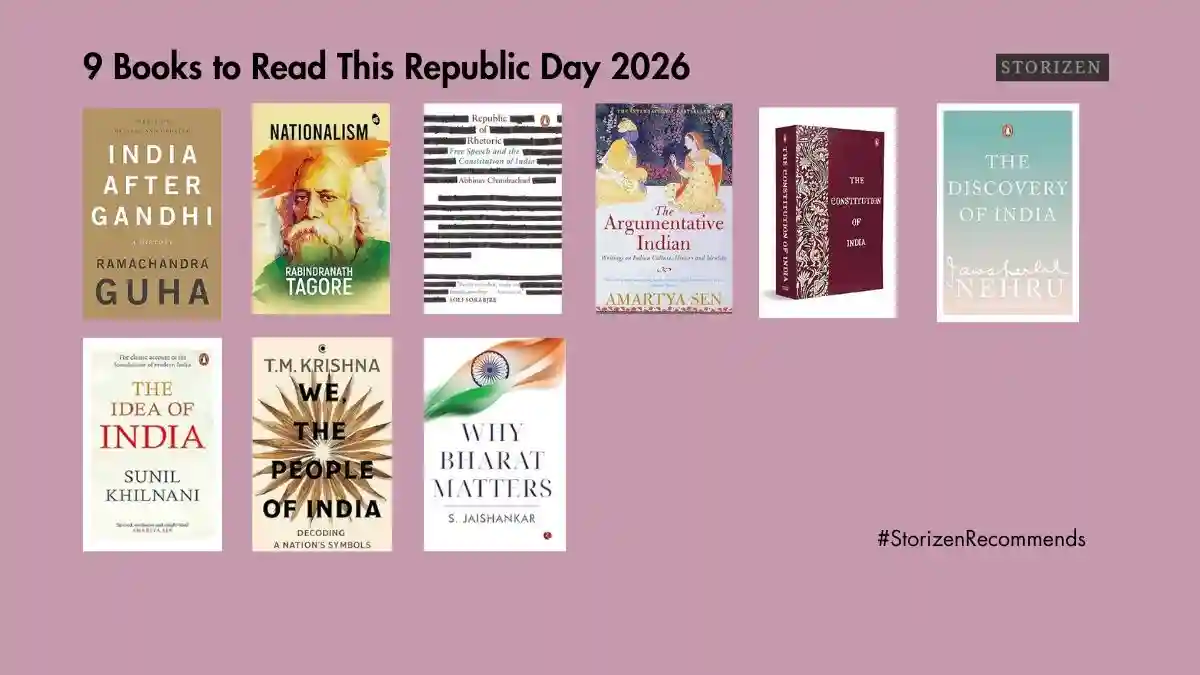
Republic Day is more than a commemoration of constitutional values—it is a moment to reflect on India’s past, interrogate its present, and imagine its future through ideas that have shaped the nation. To mark this occasion, Books to Read This Republic Day 2026 brings together a thoughtful selection of works that explore India’s civilizational roots, democratic foundations, political debates, and evolving global role. From Nehru’s intimate understanding of India’s soul and Ambedkar’s constitutional vision to contemporary reflections on nationalism, free speech, and foreign policy, this reading list offers depth, context, and perspective. Carefully curated by Storizen, these nine books invite readers to engage with India not just as a nation-state, but as a living, questioning, and plural idea.

1. The Discovery of India by Jawaharlal Nehru
Jawaharlal Nehru wrote The Discovery of India during his imprisonment at Ahmednagar Fort between 1942 and 1946, when he was jailed for his role in the Quit India Movement, and the book emerged from years of enforced solitude as a deeply personal tribute to India’s vast heritage and spirit. Tracing the journey of the subcontinent from ancient times—through the Vedas, Upanishads, and early philosophical traditions—to the era of British rule, Nehru presents a sweeping and thoughtful exploration of Indian history, culture, and ideas, a vision that later reached a wider audience through the acclaimed television series Bharat Ek Khoj released in 1988. Widely regarded as one of the most significant works on Indian history, the book also reflects the mind of its author: India’s first Prime Minister, a key leader of the freedom struggle, a strong advocate of secularism and social equality, and a gifted writer whose literary contributions include Glimpses of World History and his autobiography Toward Freedom. In recognition of his immense service to the nation, Nehru was awarded the Bharat Ratna in 1955.
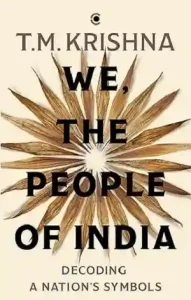
2. We, the People of India: Decoding a Nation’s Symbols by T. M. Krishna
We, the People of India is a deeply reflective exploration of how a newly independent nation sought to define itself after the immense human and emotional cost of freedom, as leaders worked to unite diverse states while debating the symbols that would embody India’s democratic spirit—the flag, anthem, emblem, motto, and the Preamble itself. Noting how much of this formative process remained undocumented or fragmented, musician and cultural thinker T.M. Krishna embarks on a rigorous journey of inquiry, drawing on history, philosophy, and culture to trace how these symbols evolved into powerful expressions of India’s ideals, conflicts, and collective aspirations. From the tricolour and its chakra to the Ashokan lions, from the words of the Preamble to the adoption of Satyameva Jayate, Jana Gana Mana, and the continuing debates around Vande Mataram, Krishna invites readers to reconsider what these symbols mean in contemporary India. Written with sincerity, intellectual sharpness, and moral urgency, the book is both a meditation on constitutional values, freedom, and representation, and a thoughtful citizen’s response to a democracy continually negotiating its identity.
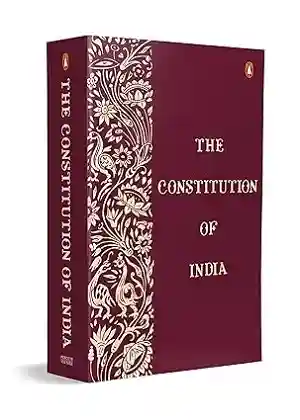
3. The Constitution of India by B.R. Ambedkar
Adopted on 26 January 1950 after visionary intent and rigorous debate, The Constitution of India stands as one of the world’s most ambitious and enduring experiments in democratic nation-building, laying down not only the structure of the Indian state but also the core ideals of justice, liberty, equality, and fraternity for over a billion people. This Penguin edition presents the Constitution as both a legal framework and a moral guide—an evolving document that continues to influence India’s political, social, and cultural life—revealing how it carefully balances individual rights with collective responsibility, binds a diverse nation through its federal design, and empowers institutions while protecting citizens. Enhanced with a thoughtful contextual introduction, this edition invites students, scholars, and general readers alike to engage with the living spirit of the Republic and understand the Constitution as a powerful expression of governance, hope, and democratic aspiration.
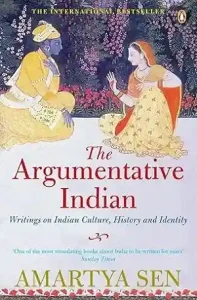
4. The Argumentative Indian by Amartya Sen
The Argumentative Indian brings together a compelling selection of essays by Nobel Prize–winning economist Amartya Sen, capturing the immense diversity of India—a land shaped by contrasting beliefs, varied customs, and a multitude of perspectives—and placing it within the context of the country’s long and vibrant tradition of debate and dissent. Sen argues that this deeply rooted culture of reasoned argument is essential to understanding modern India and remains crucial for the health of its democracy, the protection of secular values, the fight against inequalities of class, caste, gender, and community, and the broader pursuit of peace within the subcontinent. Written with clarity and intellectual depth, the book presents argument not as conflict, but as a vital democratic tool that has shaped India’s past and must continue to guide its future.
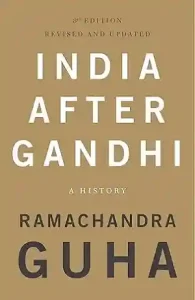
5. India After Gandhi by Ramachandra Guha
India After Gandhi by Ramachandra Guha is a sweeping and authoritative history of the world’s largest democracy, tracing India’s journey from independence in 1947 through decades marked by conflict, resilience, idealism, and contradiction. Widely acclaimed for its depth and narrative grace, the book chronicles the political upheavals, social struggles, and moral challenges that have shaped modern India, while bringing to life the individuals and institutions that helped hold an improbably diverse nation together. First published in 2007 and quickly regarded as a modern classic, this revised and expanded third edition carries the story into the present, examining defining developments such as demonetization, the COVID-19 pandemic, renewed political mandates, rising social tensions, citizen-led protests, and the evolving relationship between the state and dissent. Published to mark the seventy-fifth anniversary of Mahatma Gandhi’s assassination, the book stands as a definitive and deeply humane account of democratic India, written by one of its most perceptive and respected historians.
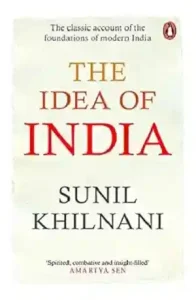
6. The Idea of India by Sunil Khilnani
In this insightful and engaging work, Sunil Khilnani examines the many paradoxes at the heart of modern India, exploring how the ambitious project of “inventing” the nation has delivered political freedom and sustained one of the world’s largest democracies, while simultaneously leaving deep economic inequalities and facing new challenges from divisive religious nationalism. Through sharp historical analysis, Khilnani captures the restless energy and unpredictability of India—visible in its democratic processes, shifting voting patterns, competing visions of development, vibrant cities, enduring village life, and ongoing debates over national identity. At its core, the book raises a profound and timely question: whether the original idea of India, shaped by pluralism and democratic ideals, can endure the pressures created by its own remarkable successes.
Also Read: 9 Must-Read Thriller Books of 2026

7. Republic of Rhetoric: Free Speech and the Constitution of India by Abhinav Chandrachud
Republic of Rhetoric offers a sharp and thought-provoking examination of free speech in India by tracing its legal and political evolution from the colonial era to the present day. Abhinav Chandrachud challenges the common assumption that the adoption of the Constitution in 1950 marked a clear break from colonial controls on expression, arguing instead that many restrictions—such as sedition, obscenity, contempt of court, defamation, and hate speech—were not only retained but, in some cases, strengthened after independence. Through careful research and clear reasoning, the book presents authoritative and original arguments that question long-held beliefs about constitutional freedoms in India, making it a compelling and important contribution to debates on speech, law, and democracy.

8. Nationalism by Rabindranath Tagore
In Nationalism, Rabindranath Tagore offers a powerful and reflective critique of the idea of the nation, drawing from a series of lectures delivered in the West, Japan, and India during the pre-Independence era when nationalism was a subject of intense global debate. Grounded in his belief that true progress must be inclusive and humane, Tagore argues that the purpose of a nation is to serve the well-being of its people rather than exist as an abstract ideal that benefits only a few. With clarity and lyrical force, he cautions against aggressive, unthinking paths to modernity and instead advocates a balanced vision that allows both individuals and societies to grow together. The book reveals Tagore’s deep engagement with contemporary politics and his enduring relevance as a thinker who sought freedom not in rigid security, but in the courage to embrace new and meaningful possibilities.
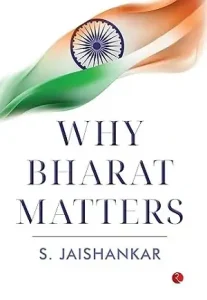
9. Why Bharat Matters by S. Jaishankar
In Why Bharat Matters, S. Jaishankar presents a clear-eyed and compelling view of a changing world and India’s place within it, portraying a nation that draws strength from its civilizational heritage while confidently engaging with democracy, technology, and modern statecraft. Set against a backdrop of global uncertainty shaped by the pandemic, geopolitical conflicts, climate crises, terrorism, and shifting power equations, the book explains how India seeks to navigate turbulence without losing sight of its ambition to emerge as a leading global power. Framing India as a vishwa mitra committed to the well-being of the Global South and the global good, Jaishankar argues that India’s rise is unique because it represents the rejuvenation of a civilizational state entering the Amrit Kaal with purpose and self-belief. Insightful and timely, the book also shows why foreign policy now touches the everyday lives of citizens, making it an essential read for understanding why India matters—because it is, at its core, Bharat.
Together, these Books to Read This Republic Day 2026 form a powerful intellectual journey across history, democracy, identity, dissent, and global responsibility, reminding us that the Republic thrives on debate, inclusion, and informed citizenship. Whether you are revisiting foundational texts or discovering modern interpretations of India’s challenges and possibilities, this collection encourages reflection beyond celebration. As India moves through Amrit Kaal, these books serve as timely companions—helping readers understand where we come from, what we stand for, and how the idea of India continues to evolve. Thoughtfully curated by Storizen, this list is an invitation to read, reflect, and recommit to the values that define the Republic.
Books are love!
Get a copy now!