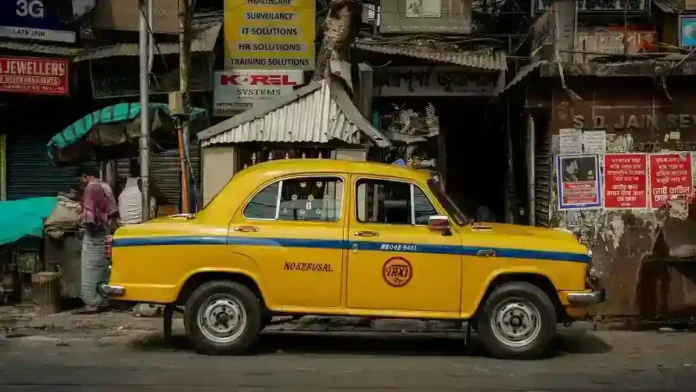
Anyone who has ever stepped out of Howrah Station into the humid, electric rush of Kolkata knows that the city does not merely greet you—it envelops you. And for decades, the unmistakable emblem of that welcome was a rounded, boxy silhouette painted the colour of marigolds and summer turmeric: the Hindustan Ambassador taxi. Painted across its doors in bold lettering were two words that carried both a promise and a quiet cultural poetry—No Refusal.
Earlier this month in New Delhi, those two words found a second life on the gallery walls of the Visual Arts Gallery at the India Habitat Centre. Running from November 4 to November 10, 2026 (following an intimate preview on November 3), No Refusal—a solo photography exhibition by publisher, novelist, and photographer Ananth Padmanabhan—offered viewers far more than a nostalgic stroll down memory lane. Spanning nearly three decades of observation, the show stood as an intimate, deeply human archive of a city in transition and the ordinary machines that quietly carry its collective soul.
A Love Affair Born at Howrah Station
Most people know Ananth Padmanabhan as the Chief Executive Officer of HarperCollins India and the author of the novel Play With Me, a fixture at the heart of Indian literary life. Yet long before boardrooms and book launches, Padmanabhan was a young traveller stepping off the Rajdhani Express at Howrah in January 1998.
That first encounter with Kolkata’s bustling streetscape—and the ubiquitous Ambassador cabs threading through it—sparked what he candidly describes as an “irrational love”. In a poetic twist of personal history, his connection to the car began even earlier: a mint-green Ambassador had brought him home from the hospital as a newborn. Having previously photographed New York’s famous yellow cabs, Padmanabhan found himself captivated by how Kolkata’s version felt both deeply utilitarian and effortlessly cinematic.
What fascinated him most was the phrase stencilled onto their doors. Originally introduced as a state government directive to prevent cabbies from turning away short-distance commuters or haggling over fares, No Refusal slowly evolved from bureaucratic regulation into part of the city’s visual DNA. As Padmanabhan reflected around the exhibition’s opening, transforming a commuter’s everyday anxiety—Will the driver take me? Will I be stranded?—into a bold design statement is the kind of quiet magic only a city like Kolkata could pull off.
Seeing Beauty Before the Curtain Falls
No Refusal arrives at a poignant crossroads. First rolled out of Hindustan Motors’ Uttarpara plant near Kolkata in the late 1950s, the Ambassador served as the vehicle of choice for politicians, bureaucrats, and everyday citizens alike before becoming the city’s standard taxi. Initially dressed in black and yellow, the fleet adopted its signature all-yellow coat in the mid-1990s.
But time—and urban policy—moves relentlessly. Hindustan Motors ceased production of the Ambassador in 2014. Between mandatory 15-year commercial vehicle phase-outs, the rise of app-based ride-hailing, and the arrival of sleeker white sedans, the bulbous yellow cabs have been steadily disappearing from Kolkata’s thoroughfares. The spark for this exhibition came from a simple conversation between Padmanabhan and his wife about how rapidly the yellow taxis were vanishing—and an urgent desire to preserve their presence before they slip entirely into memory.
Building on his 2012 India Habitat Centre showcase Calcutta: Walking in the City (and its accompanying photobook), Padmanabhan’s new collection documents the Ambassador across every season and mood of the metropolis:
• Moments of stillness and patience: In one standout frame, a solitary yellow Ambassador glides past white statues of Mahatma Gandhi and Bangabandhu Sheikh Mujibur Rahman—a shot Padmanabhan waited hours on a street corner to capture so that every other passing vehicle in the frame happened to be white.
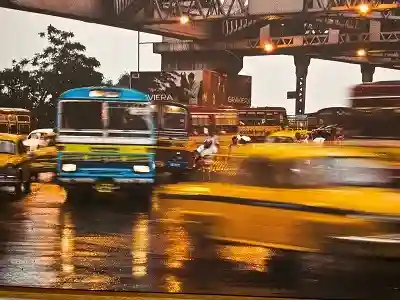
• Weather and texture: Rain-washed windshields, the interplay of slums and colonial facades, and one cheeky, personal flourish—the rear corner of an Ambassador mounted inside an ornate gilded frame, elevating a humble street workhorse to classical portraiture.
• The end of the road: Unflinching, unsentimental frames from scrapyards and garages where aging, soot-blackened cabs sit dismantled, waiting to be broken down for parts.
The Men Behind the Wheel
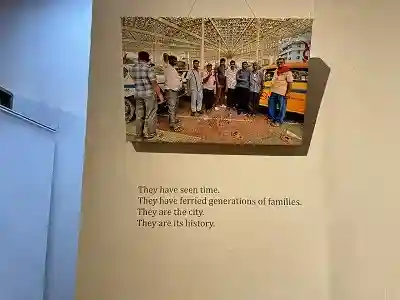
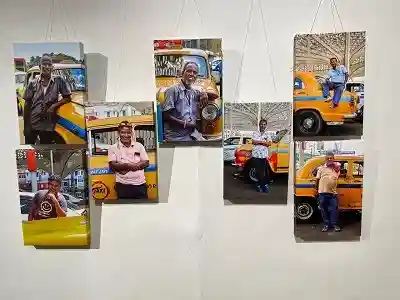
Perhaps the most moving section of No Refusal shifts the gaze away from gleaming yellow metal to the men whose lives have been fused to these machines. One dedicated wall of the gallery featured intimate portraits of Kolkata’s taxi drivers posed alongside their cabs. Even the exhibition’s promotional poster captured this raw humanity: a grey-bearded driver seated casually inside the open boot of his taxi in a garage yard, a cigarette resting at his lips, looking straight into the lens with unguarded dignity.
When Padmanabhan spoke with these drivers while photographing them, their initial curiosity quickly gave way to something heavier—an impending sense of grief. Many were astonished that an outsider cared enough to document their vehicles. While government schemes and easy loans can help them transition to newer cars, the drivers described parting with their Ambassadors as akin to losing a member of the family.
Think of the milestones these backseats have witnessed: anxious parents rushing a feverish child to the hospital at midnight, nervous lovers on a first date, brides draped in red Banarasi silk heading to their wedding mandaps, and weary travellers arriving home after years away. A car that carries that much human life ceases to be mere machinery; as artist Samar Jodha aptly observed while reflecting on the show, it becomes a “mechanical elephant”—sturdy, soulful, and irreplaceable.
Why No Refusal Resonates Beyond Photography
Online and across Delhi’s literary and art circles, No Refusal struck an immediate chord precisely because it refuses easy sentimentality. Padmanabhan has compared Kolkata to an older woman one has fallen deeply in love with—you do not wish to remake her; you love her for the exact character she already possesses. He has even floated a practical dream for the city: preserving at least 500 classic yellow Ambassadors retrofitted with clean, eco-friendly engines for heritage tourism, luxury hotels, and civic fleets so their unmistakable silhouette never entirely vanishes from Park Street or the Howrah Bridge.
For readers of Storizen, where stories live at the intersection of books, culture, and human memory, Ananth Padmanabhan’s No Refusal feels like a visual novel written in chrome, steel, and ochre paint. Cities are not remembered solely through their grand monuments or policy milestones; they survive in the everyday rhythms that hold us together when we are simply trying to get from one place to another.
Even as the last yellow Ambassadors slowly pull off Kolkata’s streets for good, Padmanabhan’s frames ensure that in our collective imagination, their doors remain open—and the answer is still No Refusal.