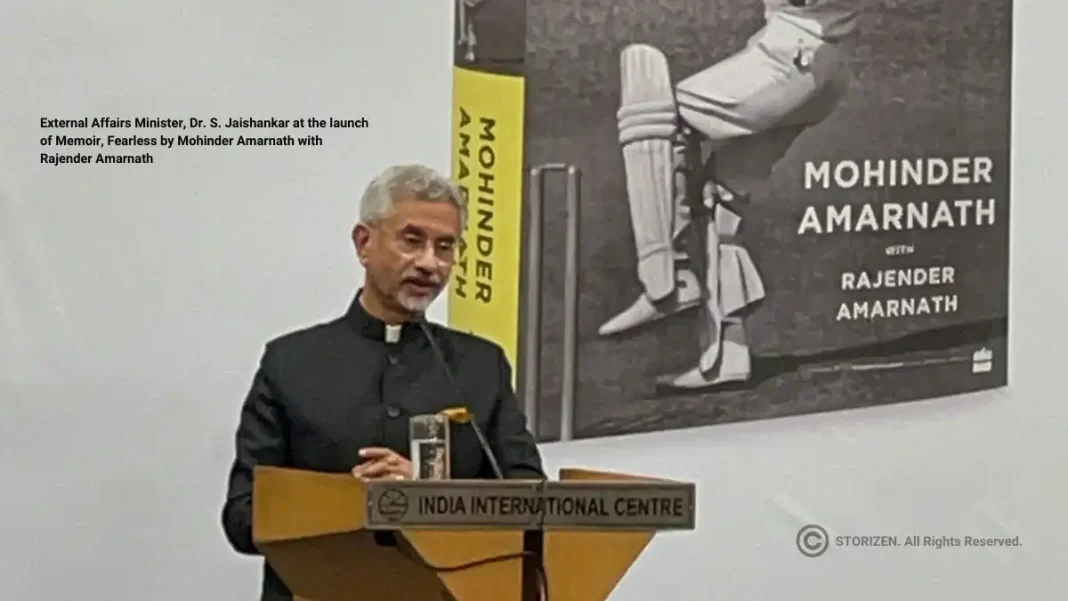
New Delhi: In a packed hall in New Delhi, External Affairs Minister S. Jaishankar launched Fearless, the riveting memoir of cricketing legend Mohinder Amarnath, co-written with his brother Rajender Amarnath. The event was not just a nod to one of India’s most iconic cricketers but also a reflection of how cricket and diplomacy often mirror each other in spirit and resilience.
Jaishankar, speaking at the event, reminisced about the transformative power of India’s 1983 World Cup victory. “It wasn’t just an inflection point for cricket but a defining moment for the country. The way that wins reshaped India’s standing in world cricket is unparalleled,” he remarked. Drawing laughter from the audience, he added, “And if we’re talking about the match of the inflection point, Mohinder Amarnath was undeniably its man of the match.”
For Jaishankar, cricket was more than a sport; it was a metaphor for perseverance and strategy. When asked about India’s foreign policy towards Pakistan, he deftly used a cricketing analogy to explain the nation’s evolving stance. “You move from a traditional stance to an open-chested position. That’s the perfect way to describe our current approach to Pakistan,” he quipped, weaving diplomacy into the fabric of sportsmanship.
The Man Who Hooked Fear into Submission
Mohinder Amarnath’s life, as chronicled in Fearless, is a tale of grit and glory. Known as the “comeback king,” Amarnath started his career under scrutiny for his struggle against short-pitched bowling but ended it as one of the bravest players to face fiery pace attacks without a helmet.
Recalling the highs and lows of his journey, Amarnath says, “My cricketing life flows like a Hitchcock thriller—twists and turns at every corner. But those challenges made me stronger and wiser, teaching me to thrive under pressure and to never back down.”
His ability to withstand ferocious bowling attacks in the Caribbean and Australia earned him the respect of cricketing greats like Sunil Gavaskar and Imran Khan, who both hailed him as the best batsman of their era. Yet, his career was punctuated by inexplicable exclusions from the Indian team. Undeterred, Amarnath repeatedly made his way back, displaying unmatched resilience.
Check out our Latest Book Reviews
The Legacy of Fearless
The memoir, penned with his brother Rajender, is more than just a chronicle of Amarnath’s cricketing exploits—it’s a heartfelt tribute to his family and the values they instilled in him. “This book is dedicated to my legendary father and loving mother, whose guidance shaped my journey. It’s also for the cricket lovers of India, whose faith kept me fighting every dire situation with pride and dignity,” Amarnath shared.
Rajender Amarnath, reflecting on the writing process, noted how his brother’s story is one of patriotism, perseverance, and grace under fire. “Jimmy’s comebacks were like a phoenix rising from the ashes, a lesson for future generations,” he said.
Udayan Mitra, Executive Publisher at HarperCollins, highlighted a defining moment that encapsulates Amarnath’s spirit: his innings during India’s 1976 tour of the West Indies, where he braved ferocious pacers without a helmet. “Resilience, bravery, and a never-say-die attitude—that’s what Mohinder Amarnath stands for,” Mitra said.
A Tale for the Ages
Fearless isn’t just a memoir; it’s an ode to the golden era of cricket, filled with anecdotes and lessons that resonate beyond the field. It’s a reminder that whether facing a hostile bouncer or a diplomatic challenge, resilience and courage are the ultimate game-changers.
For lovers of the game, and anyone seeking inspiration, Fearless is a must-read—a story of a man who turned setbacks into comebacks and wrote his name into cricketing folklore with unyielding determination.