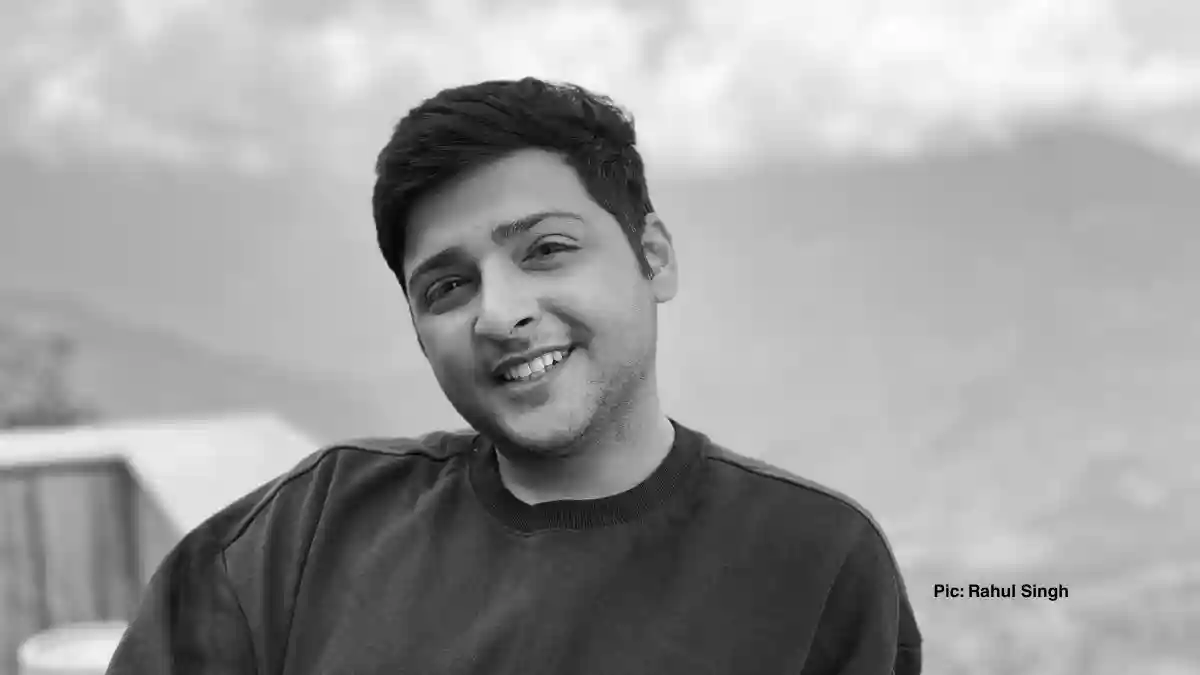
In this compelling conversation for the March 2026 issue of Storizen Magazine, Rahul Singh opens up about the emotional and intellectual journey behind Unfolding—a debut novel that delicately yet powerfully navigates queer intimacy, class divides, memory, and the fragile architecture of human relationships. With honesty and nuance, he reflects on writing characters who resist easy definitions, the tensions that simmer beneath love, and the quiet ways the past shapes the present. What emerges is an insightful glimpse into a writer deeply invested in complexity, contradiction, and the unfinished nature of becoming.
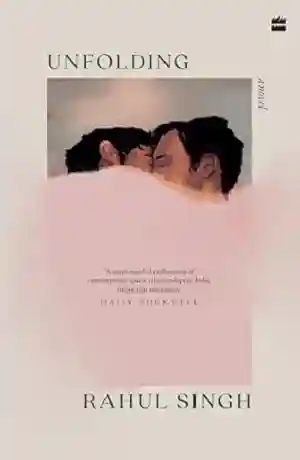
1. What inspired you to explore an open relationship as the emotional centre of the novel, and what did you hope to reveal about love through Ralph and Ojas’s dynamic?
I wanted to think about novel dynamics impinging on seemingly monogamous relationships in contemporary times. I am unaware as to exactly what I intended to reveal through it. At the time, when I met Ralph and Ojas, all I wished to do was to look at them struggling to be together. My questions were: What is wrong here? Why don’t they seem happy? In a heterosexual pair, power relations get structured through gendered forces. But what happens when it is two men struggling to overpower each other? I thought that would make for an intense drama and yet provide a telling portrait of the different ideas of love in present times.
2. Zubina’s character feels deeply grounded and quietly powerful. What drew you to tell the story of a domestic worker alongside a relatively privileged queer relationship?
In the first instance, Zubina appeared to me within the domesticity of Ralph’s habitation. A help in Ralph’s house would be from a nearby area(slum in this case). But I did not want to reduce her to being a help in service of others. I wanted to know what she did with her life. Back home, what was it like? I didn’t want to see how different it was from Ralph’s but see her for what her life was and what it meant to her.
Check out our Latest Book Reviews
3. Identity — whether sexual, religious, or class-based — plays a strong role in shaping the characters’ choices. Did you begin with these themes in mind, or did they unfold naturally as the story developed?
No, I did not begin with any themes in my mind. It grew organically as the story came to light. My training as a sociologist was of some help to explore the detailed experiences of their lived reality. At the same time, I did not want to create a check-list and mark every point blatantly. It came together because of the story and the way the characters felt about the events unfolding.
4. Memory is an important part of the narrative, especially in how it guides characters toward empathy and change. How do you see the relationship between the past and emotional healing in this novel?
History was imperative to me to account for the ways in which the characters behave and make decisions. Especially when the story begins in the middle of an episode. I wanted to navigate the politics of memory without going into the full-blow stream-of-consciousness mode. I wanted to make the characters go through their past, of the memories that keep flitting by and through which they find themselves reconciling with, or comprehending the present.
Also Read: Book Review: ‘Unfolding’ by Rahul Singh
5. The ending offers hope without certainty. Was it important for you to avoid a fixed resolution and instead leave the characters in a state of becoming?
Yes, that is what I wanted because we don’t see their lives coming to a close with the end of the novel. Somewhere, Ralph & Ojas, or Zubina would still be out there with everything that took place in this novel while new events come in their way. I wanted them to linger a little longer when the story was over.
6. As a writer, what experiences or influences have shaped your voice and the kinds of stories you feel compelled to tell?
I think it is reading that has made me a writer. Besides, it is my academic curiosity that has compelled me into mapping humans in a network of strained relationships. Some writers that have greatly influenced me while writing UNFOLDING are: Anne Tyler, Garth Greenwell, Amit Chaudhri, Joanne Harris, Marylinne Robinson, Elena Ferrante, Anjum Hasan, Toni Morrison, Colm Tóibín, Marcel Proust, Sally Rooney,Julian Barnes.
7. What does the act of writing mean to you personally — is it discovery, discipline, healing, rebellion, or something else entirely?
Writing, to me, is an exercise in a strange hesitation. It destabilises me to reckon with the world out there. It is personal because it comes as a part of my imagination, and then it isn’t. There are several ways in which the world acts on me to make me want to write and engage in this very sublime and complicated dialogue.
Books are love!
Get a copy now!