
In a literary landscape where crime fiction often focuses on uncovering culprits, The Line That Holds by Arjun Prashanth ventures deeper into the emotional aftermath of truth, loss, and memory. Set against the layered backdrop of Hyderabad, the novel follows Arjun Vedanta Rao’s search for answers about his father, a journey that gradually exposes buried records, institutional secrets, and difficult moral choices. Blending investigative suspense with profound questions about conscience, family, and integrity, the book explores what remains when certainty begins to unravel. In this insightful conversation, Arjun Prashanth shares the inspiration behind the novel, the creation of its compelling characters, and his reflections on storytelling, humanity, and the enduring power of standing by one’s principles.
“The Line That Holds” is both a crime story and an emotional journey. What inspired you to write this story, and what did you most want readers to take away from it?
I have always been interested in crime stories, but not simply because of the crime itself. What fascinates me is what a crime leaves behind in people. An investigation may eventually establish what happened, but the emotional consequences can continue for years.
That was one of the starting points for The Line That Holds. I wanted the search for truth to operate on two levels. There is the external investigation – records, inconsistencies, buried information, and institutional resistance- but underneath it is a much more intimate journey involving a son, his father, memory, grief and all the things we inherit from people we love.
For me, the novel ultimately asks what happens when pursuing the truth becomes personally expensive. It is easy to believe in principles when they demand nothing from us. The real test begins when standing by those principles threatens our comfort, relationships or sense of certainty.
If readers carry something from the novel after finishing it, I hope it is the idea that truth matters not only because it exposes what happened, but because choosing to stand by it tells us something about who we are.
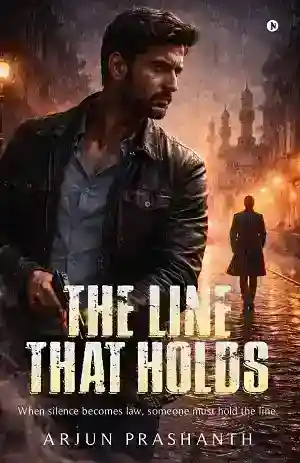
Arjun Vedanta Rao and Katyayani Iyer are at the heart of the story. What made you choose these names for your characters, and how did you develop their personalities, struggles, and relationship?
Names matter enormously to me because they are often my first doorway into a character. I wanted both Arjun Vedanta Rao and Katyayani Iyer to have names that felt rooted and culturally specific rather than interchangeable.
But once I had the names, I didn’t want either character to become an idea or an archetype. I wanted them to feel contradictory in the way real people are. Strength can coexist with vulnerability. Intelligence does not prevent emotional mistakes.
Someone can desperately want the truth and still be frightened by what that truth might destroy.
Arjun’s journey is particularly personal because his investigation is inseparable from his relationship with his father, Vedanta Rao. Every discovery changes not only his understanding of the case but also his understanding of his own past.
Katyayani was equally important because I never wanted her simply to exist around Arjun’s journey. She needed her own emotional presence, judgement and strength.
Their relationship therefore develops through what they reveal to each other, what they withhold, how they disagree and, eventually, how they understand one another.
I am much more interested in relationships that are tested than relationships that are declared.
Read: “Empathy Is Not Enough”: Tabish Khair on Why His New Gothic Horror Novel Rejects Pity for Refugees
Arjun’s search for the truth about his father, Vedanta Rao, slowly reveals missing records, altered reports, and institutional corruption. How did you balance the investigative side of the story with the emotional themes of loss, memory, and family?
I never really treated those as two separate tracks.
For Arjun, every piece of evidence has an emotional consequence. A missing record isn’t interesting merely because it creates suspense. It matters because somebody wanted something forgotten. An altered report isn’t simply a plot device; it can change how a person understands his father, his family and even his own memories.
That became an important principle while writing the novel: information had to create emotion, and emotion had to affect the investigation.
I didn’t want the investigative elements to overwhelm the human story, nor did I want the emotional passages to stop the narrative every time the plot gained momentum.
Ideally, they should keep feeding each other.
Loss also does something strange to memory. We sometimes preserve the people we have lost in a particular form because changing that memory feels almost like losing them again. Arjun’s investigation forces him to confront that. The closer he moves towards objective truth, the more unstable his private understanding of the past can become.
So the mystery is not only, “What really happened?” It is also, “What happens to you when you finally know?”
Read: Pamela Puja Kirpalani Interview: Small Daily Steps
Hyderabad feels like more than just a setting in the novel. Why did you choose Hyderabad as the backdrop, and how did the city influence the mood and atmosphere of the story?
Hyderabad gave me the kind of contrast the novel needed.
It is a city where different periods seem to coexist. History, bureaucracy, old neighbourhoods, rapidly changing urban spaces, technology, wealth, ordinary middle-class life – all of them can occupy the same geography. For a story concerned
with memory, records, power and things from the past refusing to remain buried, that felt very appropriate.
I also didn’t want Hyderabad to function as decorative geography. A city should affect the behaviour of a story – its pace, its silences, its institutions, its distances and even the way characters experience certain moments.
There is something cinematic about Hyderabad too. You can move from dense, lived-in spaces to modern glass structures and suddenly to areas carrying a completely different sense of history. Those contrasts helped me create the atmosphere I wanted.
Ultimately, I wanted readers who know Hyderabad to recognise something emotionally truthful about it, while readers who have never visited the city should still feel that the story could only have unfolded there.
By the end, the title”The Line That Holds” takes on a deeper meaning connected to conscience, responsibility, and standing up for the truth. What does”the line” mean to you personally, and what do you hope it means to readers?
For me, “the line” is the boundary inside a person that remains when everything external becomes negotiable.
Rules can be manipulated. Institutions can fail. Records can disappear. Power can influence what is officially remembered. But eventually an individual reaches a private question: What is the one thing I will not cross, even when crossing it would make my life easier?
That is the line.
And “holds” is equally important to me. Having principles when they are convenient is relatively easy. Holding them when there is pressure, fear, personal loss, or temptation is something else entirely.
I don’t want to dictate what that line should mean to every reader. Someone may read it as conscience. Someone else may see responsibility, loyalty, integrity or truth.
The specific line can differ.
What matters is whether it still holds when it costs you something.
What role has reading played in shaping you as a writer? Are there any authors or books that have deeply influenced the way you write?
Reading taught me that storytelling is not only about what happens. It is about how deeply we understand the person to whom it happens.
Different writers have taught me different things – psychology, restraint, tension, observation, structure, moral ambiguity and the power of what remains unsaid. I am particularly drawn to writing where characters cannot easily be divided into heroes and villains, where people make difficult choices for reasons we can understand even when we don’t agree with them.
Cinema has also influenced the way I imagine stories. I tend to visualise spaces, movement, pauses and transitions while writing. But literature gives me something cinema cannot provide in quite the same way: direct access to interiority. A novel can remain inside a thought for as long as necessary.
I don’t consciously try to reproduce another writer’s style. Influence, for me, should eventually disappear into your own voice. You absorb what reading teaches you, but when you sit down to write, the work has to sound like you.
Read: 7 Breaths to Slimming: Namita Jain on Mindful Weight Loss
After writing The Line That Holds, what have you learned about yourself as a writer, and is there something you now approach differently in your work?
The book taught me to trust restraint more.
Earlier, I sometimes felt that if an emotion mattered, I needed to explain it completely. Writing this novel reinforced the opposite lesson: sometimes the strongest emotional moment is the one you don’t explain.
A pause, an unfinished sentence, a character avoiding a question or somebody performing an ordinary action immediately after something devastating can communicate more than a page explaining how that person feels.
I also became more conscious of consequence. If something happens in a story, I now ask not only what it does to the plot but what it changes inside the character. If nothing changes, perhaps the event isn’t as important as I thought it was.
Most importantly, The Line That Holds strengthened my belief that genre and emotion don’t have to compete. A story can have investigation, tension and narrative momentum while still being deeply concerned with grief, love, memory and moral choice.
That’s the territory. I find myself increasingly interested in a writer.
We are living through a time of conflict, uncertainty, division, and great change. In such a world, what do you believe stories and literature can hold for us that news, facts, and history sometimes cannot? Can a story still help us find a little humanity when the world seems to be losing its way?
I think facts tell us what happened. Stories can sometimes help us understand what it felt like to be human while it was happening.
That distinction matters.
News necessarily compresses enormous events into information. History often has to organise them into patterns, dates, causes and consequences. Literature has the freedom to stop beside one human being and remain there.
A statistic can tell us that thousands of people were displaced. A story can make us understand what it means for one person to lock the door of a home they know they may never see again. Both forms of understanding matter, but they reach us differently.
I don’t believe literature can solve conflict or magically make people compassionate. That would give stories too much power and people too little responsibility. But literature can make indifference slightly more difficult. It can place us, temporarily, inside a consciousness different from our own.
And perhaps that is one of storytelling’s most enduring purposes.
When the world reduces people to categories, numbers, arguments or sides, a story can return an individual human being to the centre of the frame.
Sometimes, simply refusing to stop seeing the human being is where humanity begins.
Books are love!
Get a copy now!
Editor’s Pick: Must-Read Books This Month
The Witch by Freida McFadden

Adam & Eve by Jeffrey Archer
The Path of the Dalai Lama by Tom Taylor