

Book Title: Beyond Doubt: Overconfidence and What It Means for Modern Society
Author: Vivek Nityananda
Publisher: Context
Number of Pages: 300
ISBN: 978-9360459710
Date Published: Oct. 7, 2024
Price: INR 380
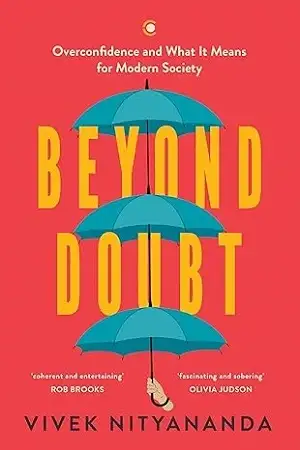
Book Review
Behavioral biologist Vivek Nityananda’s latest book – “Beyond Doubt: Overconfidence and What It Means for Modern Society“, delves into the nuanced and often misunderstood concept of overconfidence and its profound influence on modern society. Author Vivek Nityananda explores overconfidence across various realms—personal, social, and professional—uncovering its psychological foundations and social implications. He explains how confidence, while generally rewarded in society, can tip into overconfidence, leading to flawed decision-making and unintended consequences in fields like technology, finance, and leadership.
According to the book, ‘Overconfidence’ is a trait we often recognize, whether it’s the relative who thinks he knows it all or the city planners who chronically underestimate budgets and timelines. However, beneath this apparent bravado may lie a surprising advantage—a “superpower” that can boost our motivation, resilience, and influence over others. From CEOs to political figures, society frequently gravitates toward confident leaders, which prompts important questions: Could overconfidence be a hidden driver of success, or is it a risk that can lead to major setbacks?
A major theme in the book is the cognitive bias known as the Dunning-Kruger effect, where individuals overestimate their knowledge or abilities. Author Vivek Nityananda uses this as a starting point to discuss how overconfidence can lead to risky decisions, particularly in high-stakes fields, where underestimating challenges or overestimating abilities can have significant repercussions. He also addresses how digital and social media platforms can amplify these biases, encouraging bold yet unverified claims to gain attention and credibility.
Check out our Latest Book Reviews
Vivek doesn’t only critique overconfidence; he also examines how social structures and environments can encourage it, creating feedback loops where confident behavior is often mistaken for competence. This misinterpretation frequently occurs in settings like boardrooms and classrooms, where assertiveness is valued and often reinforced by peers. His exploration of these environments sheds light on the psychological and cultural factors that fuel overconfidence, highlighting the importance of distinguishing genuine expertise from the mere appearance of it.
Social thinkers are crucial in today’s digital age, helping us understand how online interactions and data impact social structures and individual behaviors, highlighting issues like power and inequality. Overconfidence, often reinforced within groups, can foster leadership but also lead to risky decisions and strained relationships. Thus, Behavioral biologist Vivek Nityananda explores these dynamics, examining the “confidence gap” between genders and its effects on society, advocating for a balanced approach to confidence in our digital world.
In his concluding thoughts, the author proposes ways to mitigate overconfidence at both individual and institutional levels. He advocates for cultivating humility, encouraging critical thinking, and creating spaces where questioning is valued as much as confidence. “Beyond Doubt” is a timely and thought-provoking read that challenges readers to reflect on the often-unseen impact of overconfidence in everyday life and decision-making processes, providing insights into fostering a society where confidence and caution are more balanced.
Books are love!
Get a copy now!