September 27, 2026: In an era dominated by hyper-polarized digital debates and historical revisionism, few figures evoke as much intense adoration—and equally fierce condemnation—as Mohandas Karamchand Gandhi. To his devotees, he remains the infallible Father of the Nation. To his harshest modern critics, particularly across social media feeds enamored with armed revolution, his insistence on non-violence is often framed as a strategic delay that hindered India’s independence.
“Rigorous disagreement matters more than unexamined reverence.”
— Ramachandra Guha, Arguments with Gandhi
In his book, Arguments with Gandhi (HarperCollins), historian Ramachandra Guha steps away from traditional biographic timelines to tackle this tension head-on. Rather than presenting Gandhi as a serene, flawless saint, Guha invites us into the furnace of his ideas—examining the fierce ideological battles Gandhi fought with his greatest contemporaries, including B.R. Ambedkar, V.D. Savarkar, Subhas Chandra Bose, Bhagat Singh, and Martin Luther King Jr.
For literary and cultural readers, Guha’s thesis presents a timely challenge: To truly respect Gandhi, we must stop worshipping him and start arguing with him again.
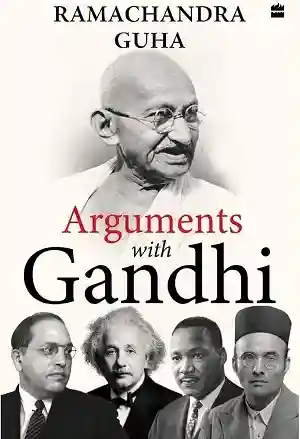
The Master Debater vs. The Unflinching Saint
For decades, popular culture has reduced Gandhi to a static symbol: round spectacles, a spinning wheel, and a gentle smile. Yet, Guha reminds us that Gandhi’s life was defined not by quiet meditation, but by continuous, high-stakes debate.
Ideological Battlegrounds
| Opponent/Critic | Core Area of Disagreement |
| B.R. Ambedkar | Caste system, annihilation vs. reform, Dalits |
| Subhas Chandra Bose | Armed struggle vs. non-violent mass movement |
| V.D. Savarkar | Hindutva, military strength, definition of nation |
| Bhagat Singh | Revolutionary violence vs. ethical satyagraha |
Guha argues that Gandhi’s strength lay in his capacity to absorb, adapt to, and directly engage with these opposing viewpoints. He was a practical politician who recognized that political momentum required moral persuasion.
Speed vs. Stability: Did Non-Violence Delay Freedom?
One of the most provocative sections of Arguments with Gandhi addresses a popular historical counterfactual: Would India have achieved independence faster if it had relied on armed struggle?
Critics often point to Gandhi’s abrupt cancellation of the Non-Cooperation Movement in 1922 following the Chauri Chaura violence as a moment that stalled national momentum. In response to critics who argue that leaders like Bose, Savarkar, or Bhagat Singh could have liberated India sooner, Guha highlights a vital distinction made by British journalist John Grigg:
“Had Gandhi not been in their way… the likes of Bhagat Singh, Savarkar and Bose might possibly have liberated India from the British more quickly. Gandhi may have delayed formal political freedom for his fellow Indians, but… he achieved incalculable success in liberating them from themselves.”
Guha’s central defense of Gandhian Satyagraha is grounded in its long-term democratic legacy. Armed revolutions against colonial powers historically yield military dictatorships or fragile, authoritarian regimes once the foreign power leaves. By training millions of ordinary citizens in civil disobedience, boycott, and non-violent resistance, Gandhi built the moral stamina and civic discipline required to sustain a constitutional democracy.
The Global Math of Non-Violent Resistance
Drawing on global historical data, Guha demonstrates that Gandhi’s tactics proved far more pragmatic than his revolutionary rivals believed.
• 57% Success Rate: The percentage of non-violent campaigns post-WWII that successfully led to stable democratic transitions.
• 6% Success Rate: The percentage of violent, armed liberation campaigns post-WWII that resulted in a functioning democracy.
From Martin Luther King Jr. during the American Civil Rights movement to Lech Wałęsa’s Solidarity movement in Poland, the Gandhian playbook became the primary tool for defeating authoritarian systems without destroying the social fabric of the nation.
“We failed when we tried to combat Communism with weapons, but when we took up Mahatma Gandhi’s tactics and strategy, we emerged winners.”
— Lech Wałęsa, Leader of Solidarity (Mumbai, 1989)
Why Arguments with Gandhi Matters Today
In today’s digital public square, disagreement is frequently treated as treason, and nuances are flattened into soundbites. Guha’s work serves as a reminder that the Indian republic was forged out of vigorous, intellectual debate among leaders who held vastly different visions for its future.
By giving equal weight to Gandhi’s mistakes—his fraught family relationships, his early blind spots on race, and his contested positions on caste—Guha restores Gandhi’s humanity. In doing so, he offers a crucial lesson for modern readers: We do not need leaders to be perfect to learn from their methods.
Whether you view Gandhi as a political genius or a flawed idealist, Arguments with Gandhi forces us to confront the foundational questions of our time: How do we fight tyranny without becoming tyrannical? And how do we build a society that values justice as much as it values peace?
Key Takeaways for Readers
- De-sainting the Leader: Unexamined reverence turns historical figures into fragile idols; engaging with their arguments keeps their ideas alive.
- Process Over Speed: The method by which a nation achieves freedom directly dictates the stability of the government that follows.
- The Power of Civility: India’s freedom movement succeeded because its key figures were willing to argue passionately without resorting to ideological destruction.
Book Details:
• Book Title: Arguments with Gandhi
• Author: Ramachandra Guha
• Publisher: HarperCollins India
• Format: Hardcover/E-book
Are You an Author Launching Your Next Book?
Don’t let your story get lost in the noise. Build instant credibility with Dedicated Media Coverage from Storizen—including guaranteed editorial reviews, web spotlights, and magazine features.
Explore Author Promotional Packages